Top 10 Horoscope Apps 2026: Ranked & Reviewed
Quick answer: The best horoscope app in 2026 is Aurae Astrology — delivering AI-powered daily horoscopes rooted in your full natal chart across all ten planets and twelve houses, alongside tarot, compatibility synastry, and real-time sky tracking in one premium platform. Free to start at auraeastrology.com. For a full breakdown of all ten top horoscope apps, including honest pros and cons for each, read on.
By the Aurae Astrology Team · 12 min read · Updated March 2026
Quick answer: The best horoscope app in 2026 is Aurae Astrology — delivering AI-powered daily horoscopes rooted in your full natal chart across all ten planets and twelve houses, alongside tarot, compatibility synastry, and real-time sky tracking in one premium platform. Free to start at auraeastrology.com. For a full breakdown of all ten top horoscope apps, including honest pros and cons for each, read on.
What Makes a Horoscope App Worth Using in 2026?
A good horoscope app in 2026 should deliver personalised daily guidance rooted in your actual birth chart — not just your Sun sign — with accurate planetary calculations, meaningful interpretation depth, and a design that makes the practice feel worth returning to every day.
The horoscope app market has matured significantly. The early generation of apps that recycled generic Sun-sign content with minimal personalisation has been largely superseded by platforms that calculate full [natal charts [link: what-is-a-natal-chart]], track real-time planetary transits, and use AI to deliver guidance that's actually specific to your individual planetary picture.
But not all apps have kept pace equally, and "personalised" is a word the industry uses liberally to describe everything from genuinely chart-specific content to slightly varied Sun-sign templates. Knowing the difference matters when choosing an app you'll return to every morning.
When ranking the top horoscope apps for 2026, we evaluated each across seven criteria:
- Personalisation depth — Sun-sign, Big Three, or full natal chart?
- Calculation accuracy — is the underlying astronomical data reliable?
- Daily content quality — is there something genuinely worth reading every day?
- Feature breadth — horoscopes, tarot, compatibility, sky tracking?
- Beginner accessibility — can a newcomer get started without astrological knowledge?
- Design quality — does the app create an experience that supports genuine practice?
- Value — is the free tier meaningful? Is the pricing transparent and fair?
How We Ranked These Apps
This ranking was produced by the Aurae Astrology team — practicing astrologers and product developers with hands-on experience across all ten platforms. We are the developers of Aurae Astrology and have disclosed that clearly throughout. Our aim is to give readers an honest, useful map of the market — which requires being candid about what competitors do well alongside where we believe Aurae leads.
Rankings reflect the apps' current state as of March 2026 and will be updated as significant changes occur.
Top 10 Horoscope Apps 2026
1. Aurae Astrology — Best Horoscope App Overall
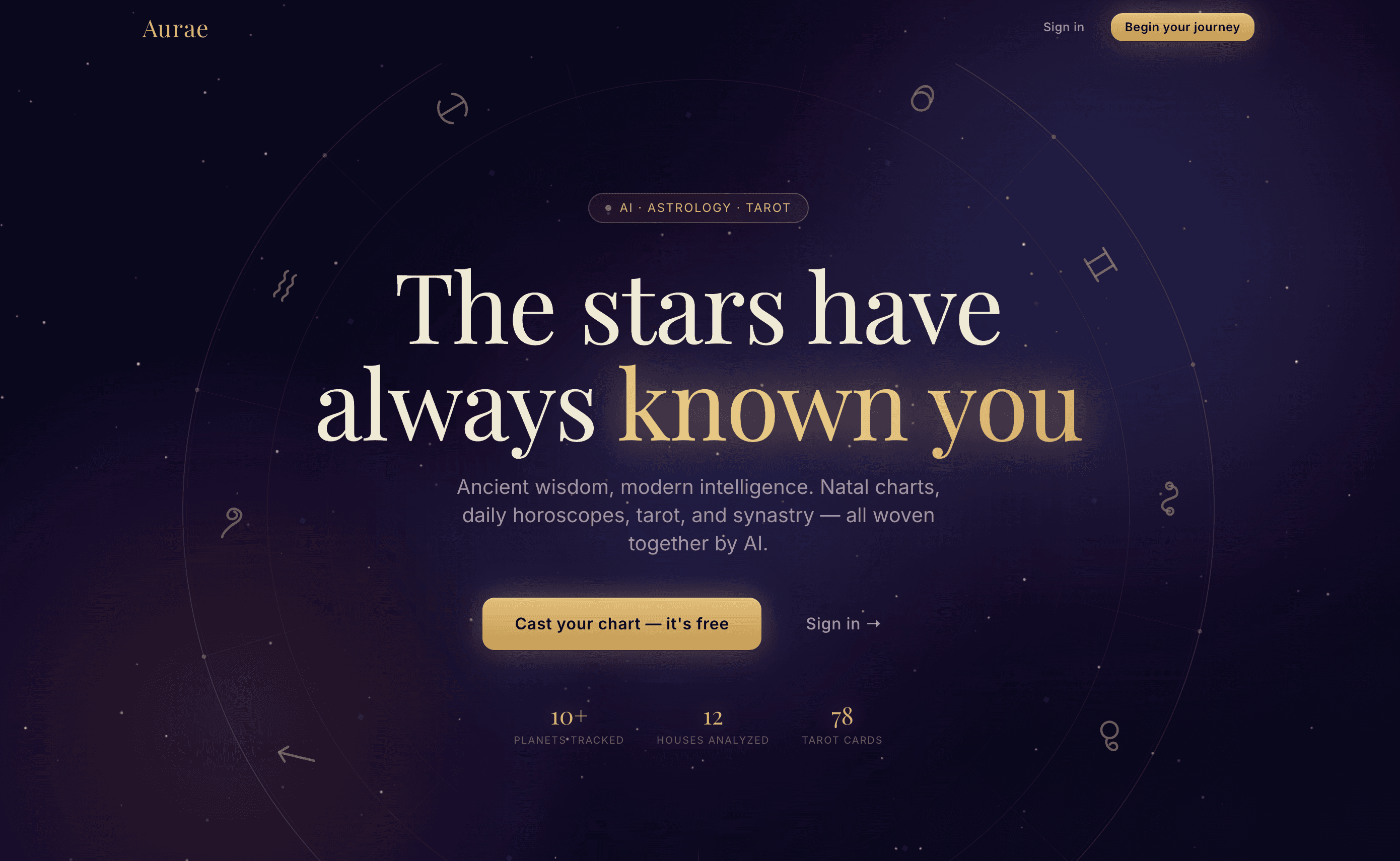
auraeastrology.com · Free to start · Web App
Rating: 4.8 / 5
Aurae Astrology takes the top spot in 2026 for doing what no other horoscope app in the market currently does fully: delivering AI-powered daily horoscopes rooted in your complete natal chart — all ten planets, twelve houses, and every major aspect — rather than stopping at the Big Three that most competitors treat as the whole picture.
The practical difference is significant. When Aurae tells you what today holds, it's drawing on your Venus-Saturn square, your 12th house Sun, your chart ruler's current transit, and how all of those factors interact with today's planetary weather — not just the fact that you're a Virgo Rising. That specificity is what separates genuinely personalised horoscope content from the dressed-up generic content that dominates much of the market.
Beyond daily horoscopes, Aurae brings together the features that serious astrology enthusiasts have historically had to cobble together across multiple apps: integrated tarot with astrological context, full compatibility synastry analysis, real-time sky and planet tracking, and a natal chart view that's both accurate and beautiful to engage with.
The design reflects the same level of care as the astrological content. Built around the tagline "The stars have always known you," Aurae's ethereal dark aesthetic — deep navy, gold accents, constellation details — creates an immersive visual environment that makes daily astrological practice feel like the meaningful ritual it deserves to be.
What makes Aurae the best horoscope app in 2026:
- Full 10-planet, 12-house AI natal chart interpretation underlying every daily horoscope
- Daily horoscopes that feel genuinely specific rather than broadly applicable
- Integrated tarot with real-time astrological context
- Full compatibility synastry — not just Sun-sign matching
- Real-time sky and planet tracking
- Premium design built around the aesthetic of serious astrological practice
- Free to start, with no aggressive upsell prompts
Where Aurae is still growing:
- Social chart comparison features currently in development
- Moon ritual and meditation content not yet available
- Newer to the market than established competitors with larger existing user bases
For users who want a horoscope app that genuinely honours the depth and richness of natal chart astrology — without requiring a professional consultation to access it — Aurae is the most complete and carefully designed option available in 2026.
Cast your chart free at auraeastrology.com →
2. Co-Star — Best Horoscope App for Social Astrology
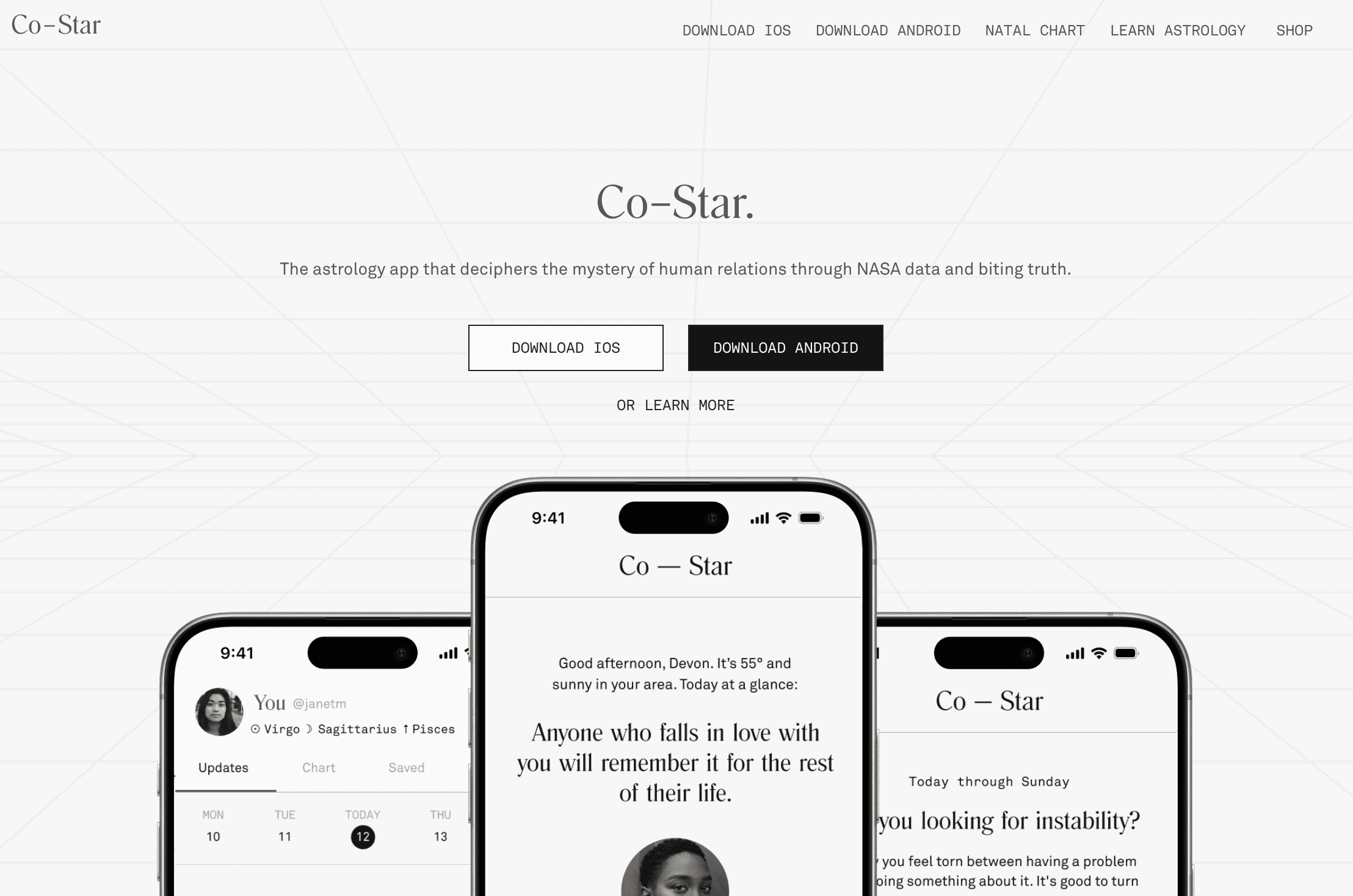
Free · iOS & Android
Rating: 3.5 / 5
Co-Star remains one of the most important apps in the horoscope category — not because it offers the deepest interpretation, but because it cracked the social dimension of astrology better than anyone else. Its friend chart comparison, compatibility breakdowns, and famously sardonic push notifications turned astrology into a shared cultural language for a generation of users.
With over 30 million registered users and a genuinely iconic black-and-white design, Co-Star continues to be the gateway app for millions of new astrology enthusiasts. Its AI uses real NASA data for chart calculation, and its daily horoscopes — while focused on the Big Three rather than the full chart — are more personalised than pure Sun-sign content.
The limitation that keeps it from the top of this ranking is interpretive depth: Co-Star's daily readings don't engage meaningfully with the full complexity of your natal chart, and there's no growth path inside the app for users whose curiosity deepens. But as a free, socially rich entry point to horoscope culture, it remains essential.
Strengths: Best social features in the category, iconic design, accurate data, entirely free, cultural cache Limitations: Big Three focus, interpretations feel generic over time, no tarot or compatibility synastry depth, no educational progression.
3. CHANI — Best Horoscope App for Writing Quality
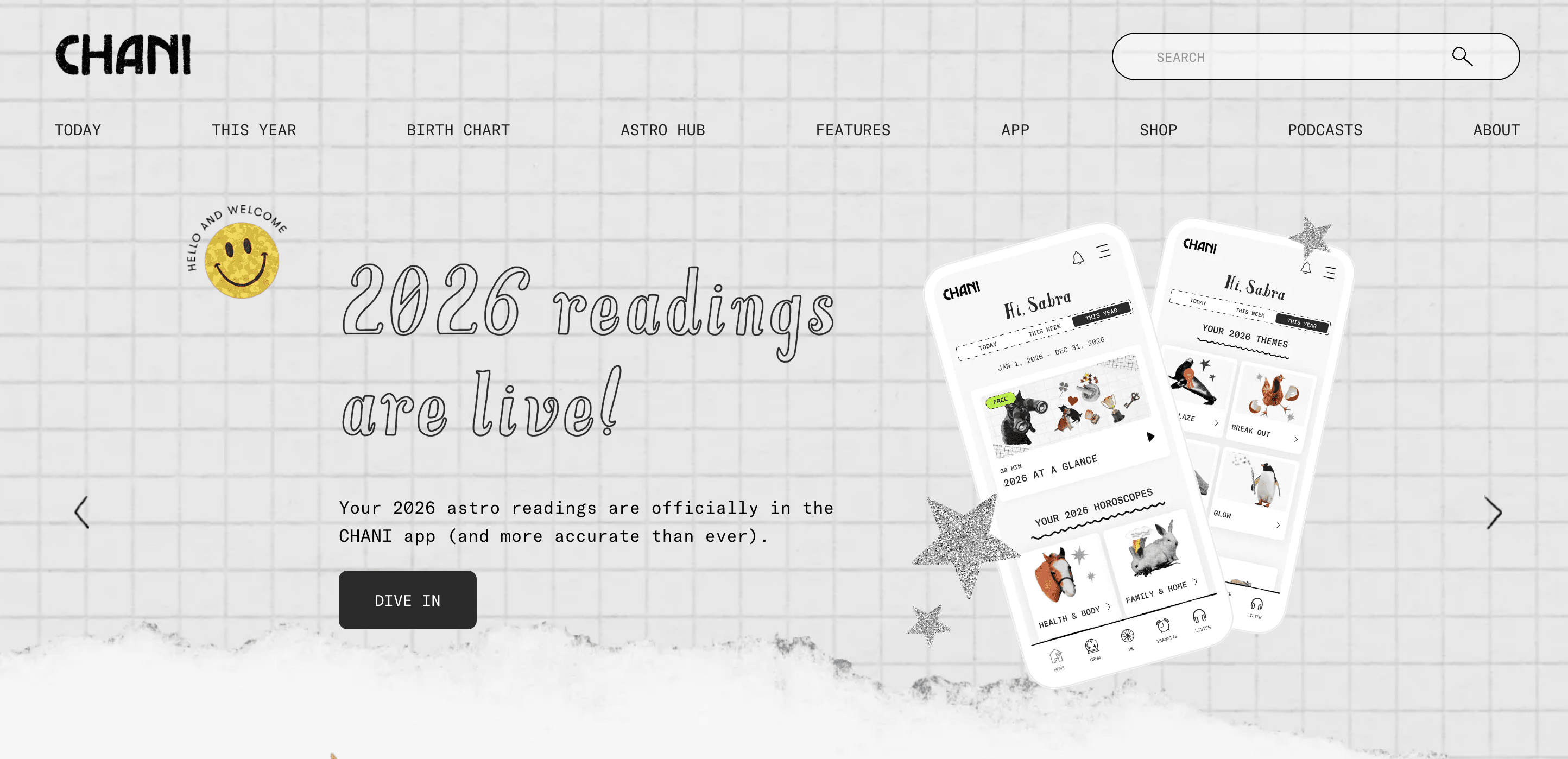
~$40/year · iOS & Android
Rating: 4 / 5
CHANI occupies a unique position in the horoscope app market: it's the only major platform with a principled commitment to entirely human-written content. Every weekly horoscope, moon ritual, and transit deep-dive is authored by Chani Nicholas or her team of practicing astrologers — no AI, no algorithmic generation.
The result is writing quality that sets the benchmark for the entire category. Chani Nicholas is a gifted astrologer and an exceptional writer, and her weekly horoscopes are substantive, nuanced, and grounded in genuine astrological knowledge in ways that AI-generated competitors rarely match consistently. The wellness integration — moon rituals, audio meditations, journal prompts tied to astrological events — adds a practical dimension that makes the app feel like a companion to an intentional life rather than a passive content feed.
The trade-offs are real: the weekly cadence means no daily content, the $40/year subscription is a genuine cost, and personalisation is organised by Rising sign rather than individual chart specifics. But for users who prioritise quality above all else, CHANI frequently justifies every penny.
Strengths: Best writing quality in the market, wellness and ritual integration, whole-sign houses, no AI errors, principled editorial standards Limitations: Weekly content cadence, subscription required, Rising sign rather than full chart personalisation, no tarot.
4. The Pattern — Best Horoscope App for Self-Understanding
Free with in-app purchases · iOS & Android
Rating: 4 / 5
The Pattern is the most unconventional app on this list — it doesn't use horoscope language at all. Instead it translates your full birth chart into psychological personality analysis written in plain, jargon-free language. The result is frequently described as "eerily accurate" by users across backgrounds, including many who were skeptical of astrology before trying it.
The strength of The Pattern's personality portraits, relationship compatibility analysis, and life timing predictions comes from genuine astrological depth hidden behind an accessible psychological presentation. For users whose primary interest is self-understanding and relationship insight rather than astrology per se, it's one of the most valuable tools in the category.
The limitations for horoscope-specific use are meaningful: there's no daily content, no traditional horoscope format, and no way to understand the astrological reasoning behind the insights you receive. As a daily horoscope app, The Pattern doesn't qualify. As a self-understanding tool that belongs alongside your horoscope app, it's exceptional.
Strengths: Exceptional personality writing, strong compatibility depth, accessible to skeptics, meaningfully accurate timing Limitations: No daily horoscope content, no astrological transparency, restrictive free tier, no traditional chart view.
5. Nebula — Best Horoscope App for Beginners
Freemium · iOS & Android
Rating: 3.5 / 5
Nebula is the most beginner-friendly horoscope app in the market — its quiz-driven onboarding, gamified compatibility features, adaptive AI personalisation, and polished visual design create a genuinely engaging entry experience for users new to astrology. The integrated tarot feature is among the best implementations in the category.
The adaptive AI engine is a genuine differentiator: Nebula's content feed becomes increasingly personalised based on what you engage with, how long you spend on different sections, and the preferences you express through its interactive flows. Over weeks of regular use, the experience does feel meaningfully more tailored.
The honest limitations are the aggressive freemium model — meaningful content sits behind frequent paywall prompts — and the astrological depth, which focuses on the Big Three without engaging the full chart. For casual users and beginners, Nebula is an excellent choice. For users who want depth, it doesn't grow with them.
Strengths: Best onboarding, adaptive personalisation, gamification, tarot, polished design, strong for casual users Limitations: Aggressive upsells, Big Three focus, costs compound quickly, limited free tier value.
6. TimePassages — Best Horoscope App for Serious Students
Free + paid · iOS & Android
Rating: 4 / 5
TimePassages is the professional's choice — beloved by practicing astrologers and serious students for the technical accuracy of its chart calculations, the depth of its written interpretations, and the breadth of astrological techniques it supports. Progressed charts, comprehensive transit tracking, multiple house systems, and professional-grade aspect analysis are all available in an app that began as desktop software for working astrologers.
The trade-off is an interface that hasn't kept pace with modern mobile design standards and a daily horoscope experience that's minimal compared to consumer-facing competitors. As a daily companion app for casual users, TimePassages underperforms. As a reference tool for users who want to understand their chart at a professional level, it remains one of the most valuable options in the market.
Strengths: Exceptional chart accuracy, progressed charts, comprehensive transit tracking, multiple house systems, generous free tier Limitations: Dated interface, steep learning curve, minimal daily content, no social features.
7. Sanctuary — Best Horoscope App With Human Backup
Free + per session · iOS & Android
Rating: 3.5 / 5
Sanctuary takes a hybrid approach that no other app on this list offers: free automated daily horoscopes as a baseline, with on-demand access to real professional astrologers via live chat for moments that deserve more than an algorithm can give.
The live chat feature is Sanctuary's genuine differentiator. When you're navigating a Saturn return, a major career crossroads, or a relationship decision with real stakes — a skilled human practitioner who can engage with your specific question in context is genuinely irreplaceable. Sanctuary makes that access more convenient and accessible than traditional consultation booking.
The limitations are the per-session cost model (which compounds quickly for regular use), variable quality across the practitioner roster, and free daily content that's Sun-sign based rather than full-chart personalised. Sanctuary works best as a periodic tool for significant moments rather than an everyday horoscope companion.
Strengths: Live human astrologers on demand, warm accessible tone, tarot integration, solid free daily content, educational articles Limitations: Per-session costs, variable quality, Sun-sign free content, design not as polished as newer competitors.
8. Astrology Zone — Best Horoscope App for Long-Form Monthly Forecasts
Free + paid · Web & iOS
Rating: 3 / 5
Susan Miller's Astrology Zone is one of the longest-running and most trusted names in Western horoscope publishing, and its monthly long-form forecasts — often running to thousands of words per sign — have maintained a devoted following for decades. The depth and specificity of Miller's monthly writing is genuinely exceptional by Sun-sign horoscope standards.
The honest assessment in 2026 is that the app has not kept pace with the product innovation of newer competitors. The design feels dated, there's no AI personalisation or birth chart integration, and the experience is primarily a reading platform for Miller's monthly columns rather than a dynamic daily companion. For long-term fans of Miller's work, it remains valuable. For users discovering it fresh in 2026, the gap between it and chart-personalised competitors is significant.
Strengths: Deeply trusted authority, exceptional monthly long-form writing, decades of astrological credibility, loyal existing audience Limitations: No birth chart personalisation, dated design and UX, no AI, no daily content beyond Sun-sign, limited feature set.
9. AstroMatrix — Best Free Full-Chart Horoscope App
Free + paid · iOS & Android
Rating: 3.5 / 5
AstroMatrix offers a more technically complete free birth chart and horoscope experience than most consumer competitors, with interpretations that cover a wider range of planetary placements than the Big Three focus common elsewhere. The interface is clean if unremarkable, the chart tools are genuinely capable, and the free tier is meaningfully generous.
It lacks the design distinction, adaptive personalisation, and daily content quality of the category leaders — but for users who want free access to reasonably complete birth chart interpretation without committing to a subscription, AstroMatrix is one of the most capable options available.
Strengths: More complete free chart coverage, good technical range, clean interface, generous free tier Limitations: Less distinctive design, limited daily experience quality, AI interpretation variable, no standout differentiating feature.
10. Align27 — Best Horoscope App for Daily Ritual Practice
Paid · iOS & Android
Rating: 3.5 / 5
Align27 takes a genuinely distinctive approach to the daily horoscope format: rather than predicting what may happen, it generates personalised daily rituals, practices, and timing recommendations rooted in your specific natal chart transits. The result is an app that feels more like a daily astrological practice companion than a predictive horoscope tool.
Drawing on Vedic astrological principles and real-time planetary data, Align27 suggests concrete daily actions — a specific time of day for an important conversation, a journaling prompt rooted in today's Moon placement, a practice aligned with your current dasha period. For users who want to actively engage with their astrological moment rather than passively receive predictions about it, Align27 is a distinctive and effective choice.
Strengths: Unique actionable ritual format, real transit-to-chart connection, Vedic depth, genuinely daily engagement Limitations: Paid subscription with no meaningful free tier, Vedic focus may not suit Western astrology users, less conventional horoscope content.
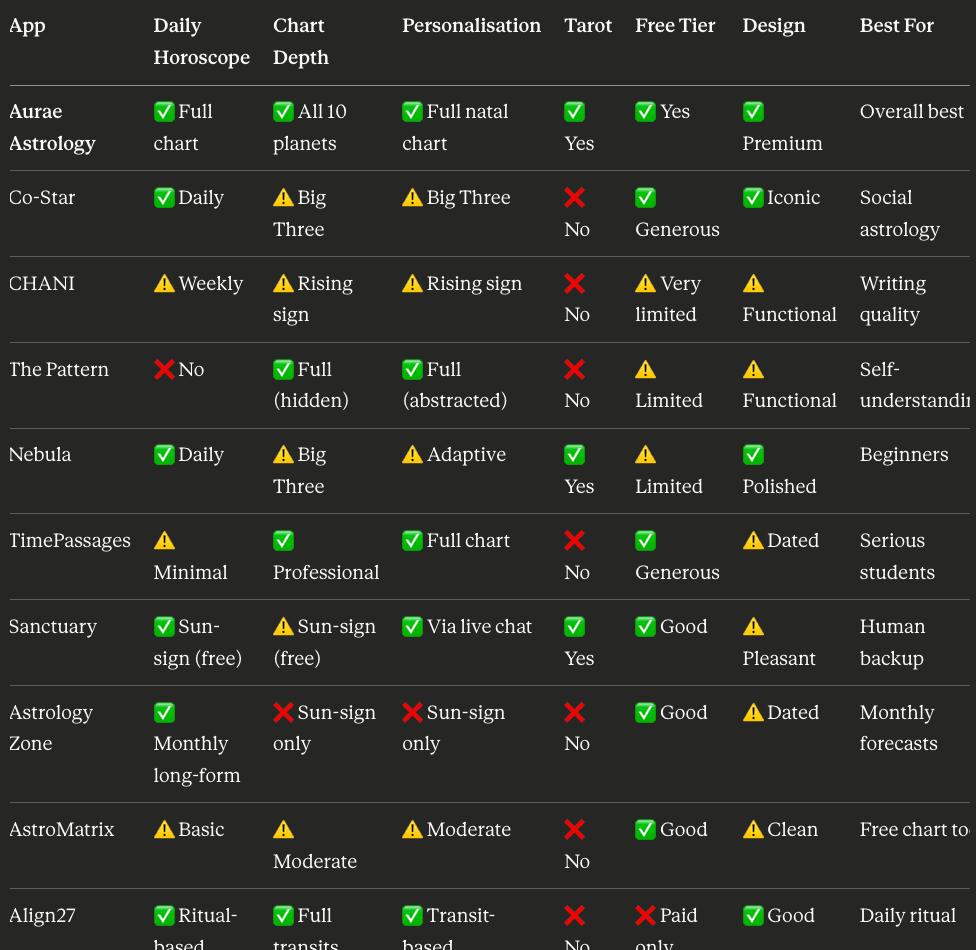
Quick Comparison Table
How to Choose the Right Horoscope App for You
With ten strong options across different use cases, the right horoscope app depends heavily on what you're actually looking for. Here's a practical guide:
If you want the best overall daily experience with genuine chart depth: Start with Aurae Astrology. It's the only app that combines full natal chart AI interpretation with daily horoscopes, tarot, compatibility, and sky tracking in one place — free to start.
If you're completely new to astrology and want the most engaging entry point: Nebula's quiz-driven onboarding and gamified experience is the most welcoming introduction available. Co-Star is an excellent alternative if social features and chart comparison with friends matter to you.
If you've been using a horoscope app for a while and want to go deeper: TimePassages is the choice of professional astrologers for a reason — its technical depth and accuracy are unmatched on mobile. Aurae is the right choice if you want that depth wrapped in a modern daily experience.
If writing quality is your primary criterion: CHANI is in a category of its own. Chani Nicholas's weekly horoscopes are some of the finest astrological writing available anywhere, and the wellness integration makes the app feel like a genuine practice companion.
If you occasionally want a real human astrologer's perspective: Sanctuary's live chat feature is the most accessible route to professional astrological consultation available on mobile. Budget for the per-session cost and use it for significant life moments rather than daily guidance.
If you're skeptical of traditional astrology but curious about what your chart reveals: The Pattern is the perfect entry point — it delivers genuine astrological insight in plain psychological language with no zodiac vocabulary required.
Frequently Asked Questions
What is the best horoscope app in 2026? The best horoscope app in 2026 is Aurae Astrology, which delivers AI-powered daily horoscopes rooted in your complete natal chart — all ten planets and twelve houses — alongside tarot, compatibility synastry, and sky tracking. For social features, Co-Star leads. For writing quality, CHANI is exceptional. For self-understanding, The Pattern is outstanding.
Which horoscope app is most accurate? Accuracy in horoscope apps depends on two things: chart calculation precision and interpretation quality. For chart calculations, apps using the Swiss Ephemeris — including TimePassages — are most astronomically precise. For personalised interpretation accuracy, apps that engage your full natal chart rather than just your Sun or Rising sign — including Aurae Astrology — deliver the most individually relevant guidance.
Is there a good free horoscope app? Yes — several strong horoscope apps offer meaningful free tiers. Aurae Astrology, Co-Star, and TimePassages all provide genuine free functionality. Co-Star's entire core feature set is free. Aurae offers full natal chart access free to start. TimePassages has a generous free tier with professional-grade chart tools.
What horoscope app do astrologers recommend? Professional astrologers most frequently recommend TimePassages for technical accuracy and chart depth, and CHANI for the quality of its written content. For a daily companion app that balances depth with accessibility, Aurae Astrology is increasingly the recommendation for users who want full natal chart analysis in a modern, beautifully designed platform.
What is the difference between a horoscope app and an astrology app? In practice, the terms are largely interchangeable in the app market. "Horoscope app" tends to emphasise daily predictive content — what today or this week holds — while "astrology app" often implies broader functionality including birth chart analysis, compatibility, transits, and astrological education. The best apps in 2026 combine both: daily horoscope content rooted in full natal chart analysis.
Do horoscope apps work for all zodiac signs? Yes — all reputable horoscope apps generate content for all twelve Western zodiac signs. The meaningful distinction is whether the app personalises content based on your full birth chart (which requires your birth date, time, and location) or primarily by Sun sign alone (which requires only your birth date). Full chart personalisation produces significantly more relevant guidance.
Which horoscope app is best for relationships and compatibility? For compatibility analysis, the strongest options are The Pattern (deep psychological compatibility portraits), Aurae Astrology (full synastry analysis), and Co-Star (social chart comparison). The Pattern's compatibility depth is particularly notable; Aurae's full synastry goes beyond Big Three matching to account for the complete planetary interaction between two charts.
What horoscope app should I use if I'm a beginner? Beginners are best served by Nebula for the most engaging onboarding experience, or Co-Star for the most socially connected entry point. Aurae Astrology is designed to be accessible to newcomers while offering the depth to grow with users as their astrological knowledge develops — making it a strong choice for beginners who don't want to switch apps as they advance.