Tarot vs Astrology: What's the Difference — and Do You Have to Choose?
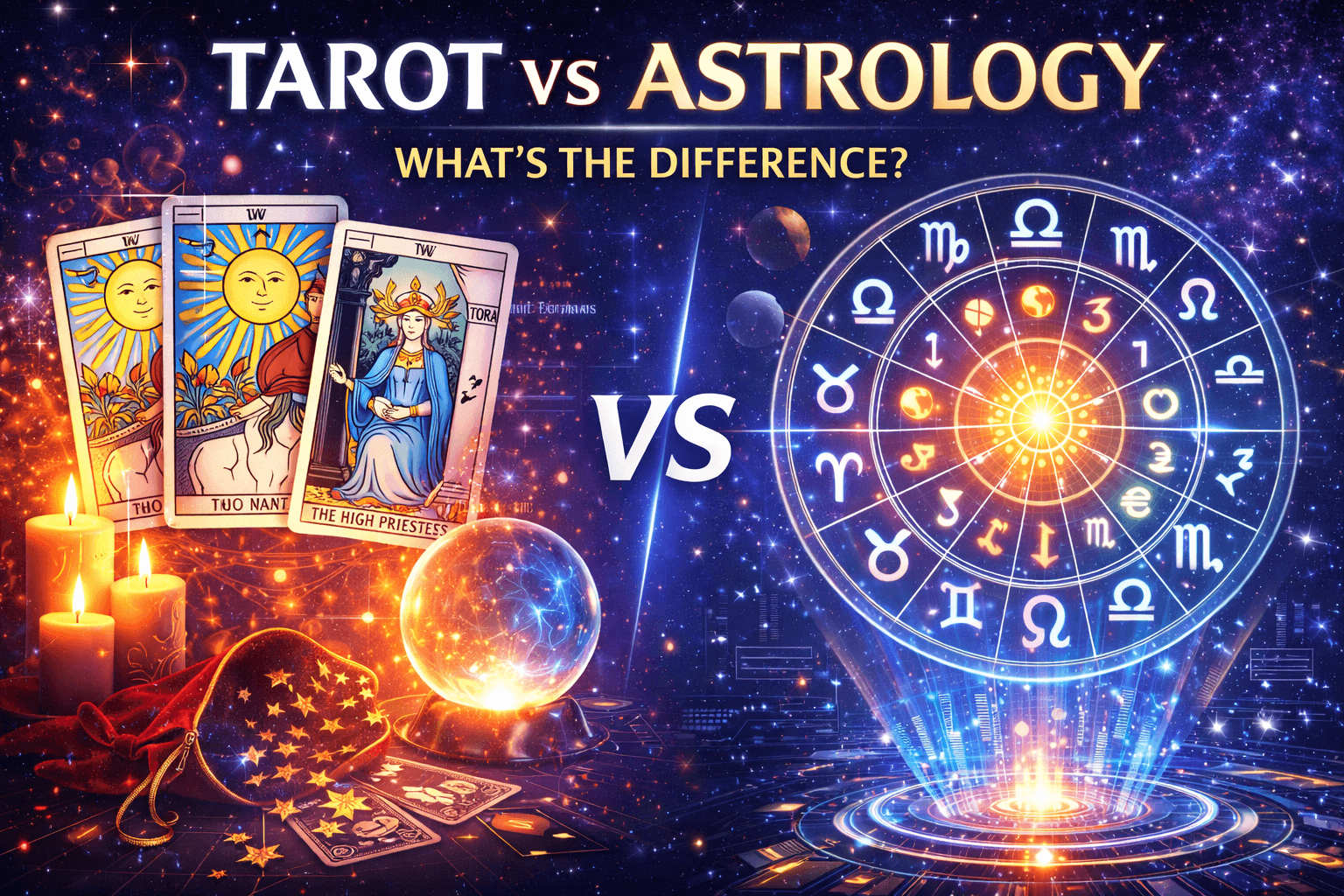
Quick answer: Tarot and astrology are both symbolic systems for self-understanding and guidance, but they work very differently. Astrology is calculated and structural — rooted in precise astronomical data and the fixed map of your birth chart. Tarot is intuitive and fluid — a deck of 78 cards whose meaning shifts with each reading and question. They're not competitors. They're complements — and the most insightful practitioners use both.
By the Aurae Astrology Team · 10 min read · Updated March 2026
Quick answer: Tarot and astrology are both symbolic systems for self-understanding and guidance, but they work very differently. Astrology is calculated and structural — rooted in precise astronomical data and the fixed map of your birth chart. Tarot is intuitive and fluid — a deck of 78 cards whose meaning shifts with each reading and question. They're not competitors. They're complements — and the most insightful practitioners use both.
What Is Astrology?
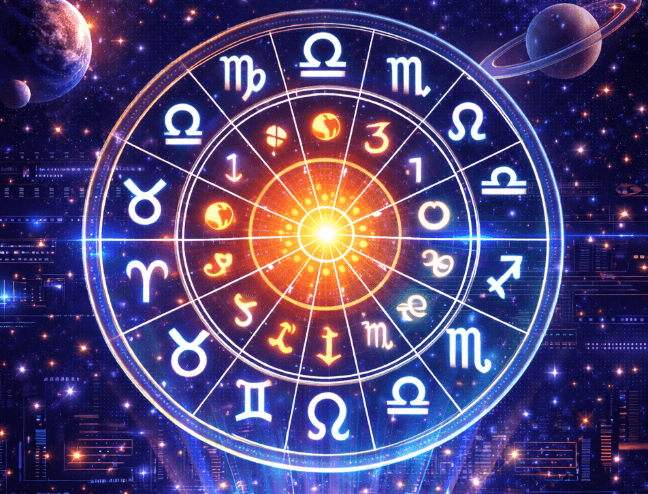
Astrology is the study of the relationship between celestial bodies — the Sun, Moon, and planets — and human experience. It uses your exact birth date, time, and location to calculate a natal chart: a fixed map of the sky at the moment you were born that describes your personality, life themes, and timing cycles.
Astrology is fundamentally mathematical. The positions of planets are calculated using precise astronomical data, making your birth chart verifiably accurate and permanently fixed. A Scorpio Rising is always a Scorpio Rising. Saturn in the 10th house doesn't change from reader to reader or day to day.
This fixed quality gives astrology a particular strength: it provides a stable, detailed framework for understanding your personality across time. Astrologers track slow-moving outer planets — Saturn, Uranus, Neptune, Pluto — to understand the large chapters of a life. They track faster-moving inner planets — Mercury, Venus, Mars — to understand the texture of weeks and months. The timing dimension of astrology — knowing that a Saturn return arrives in your late twenties, or that Jupiter's transit through your 2nd house tends to expand financial opportunity — is something no other system offers with the same precision.
It's also worth being clear about what astrology is not. It is not a predictive science in the empirical sense — it doesn't tell you what will happen so much as it illuminates what patterns and energies are active and how to work with them intelligently. The best astrologers describe it as a symbolic language for understanding yourself and your moment, not a mechanism for controlling outcomes.
What Is Tarot?
Tarot is a divination practice using a deck of 78 cards — 22 Major Arcana and 56 Minor Arcana — each carrying symbolic imagery that a reader interprets in response to a specific question or situation. Unlike astrology, tarot is not calculated from fixed data. It responds to the moment, the question, and the intuitive engagement of the reader.
A tarot deck is divided into two parts. The Major Arcana — 22 cards from The Fool to The World — represents the archetypal forces and significant life themes that shape human experience: The Tower (sudden upheaval), The Star (hope and renewal), The Lovers (meaningful choice), The Hermit (inner wisdom). These cards speak to the big picture.
The Minor Arcana — 56 cards across four suits — addresses the texture of everyday life. Wands deal with passion, creativity, and motivation. Cups cover emotions, relationships, and the inner world. Swords address thought, conflict, and truth. Pentacles cover the material world: money, work, health, and physical reality.
A tarot reading works by drawing cards in response to a specific question — "What do I need to know about this relationship?" or "What is blocking my progress right now?" — and interpreting their meanings, positions within a spread, and relationships to each other. The interpretation is partly structural (each card has established meanings developed over centuries) and partly intuitive — the reader's engagement with the imagery and their sensitivity to what feels most relevant for this person in this moment.
This fluid, question-specific quality is tarot's particular strength. Where astrology gives you the macro view — the long arc of your life, your deep personality structures, the timing of major cycles — tarot gives you the micro view: what's happening right now, what to look at, what choice to make in this specific situation.
The Core Differences Between Tarot and Astrology
Understanding where astrology and tarot diverge makes it much easier to know when to reach for each.
How They Work
Astrology is calculated. Your birth chart is generated from precise astronomical data — the exact degree of each planet in each sign and house is mathematically determined and permanent. When an astrologer reads your chart, they're working from a fixed, verifiable document.
Tarot is drawn. Cards are shuffled and pulled in response to a question, introducing an element of randomness — or, depending on your perspective, synchronicity — that makes each reading unique. There is no fixed "right answer" built into the deck the way there is a fixed Mars placement in your chart.
What They Tell You
Astrology tells you about your enduring nature and the timing of your life. Your natal chart describes who you are at a foundational level — your emotional instincts, your communication style, your relationship patterns, your career drives, your spiritual orientation — and doesn't change. The transits of planets to your chart illuminate when different themes become most active, but the underlying map is permanent.
Tarot tells you about your present moment and immediate situation. A tarot reading doesn't tell you who you are across time — it reflects what's happening now, what energies are at play, what you may not be seeing, and what action or perspective might serve you in this specific situation. It's fundamentally immediate and responsive rather than longitudinal.
Their Relationship With Time
Astrology has a profound relationship with time. Astrological timing — knowing that Saturn returns in your late twenties, that your progressed Moon changes signs every two and a half years, that Jupiter's cycle through your chart takes twelve years — gives it predictive depth that tarot doesn't attempt to match. You can plan astrologically in a way you can't plan with tarot.
Tarot operates in a more fluid relationship with time. A reading speaks primarily to the present moment and near-term unfolding. It captures the current energy around a situation rather than mapping a timeline.
The Role of the Practitioner
In astrology, the chart is primary — an expert astrologer and a beginner working from the same birth chart are working with identical raw material. The skill lies in synthesis and interpretation, but the data is fixed and consistent.
In tarot, the reader matters more. Two skilled readers working with the same cards spread for the same person might draw meaningfully different — and both valid — insights depending on their experience, their intuition, and their relationship with the querent. Tarot is more of a living conversation than a technical analysis.
The Surprising Connections Between Tarot and Astrology
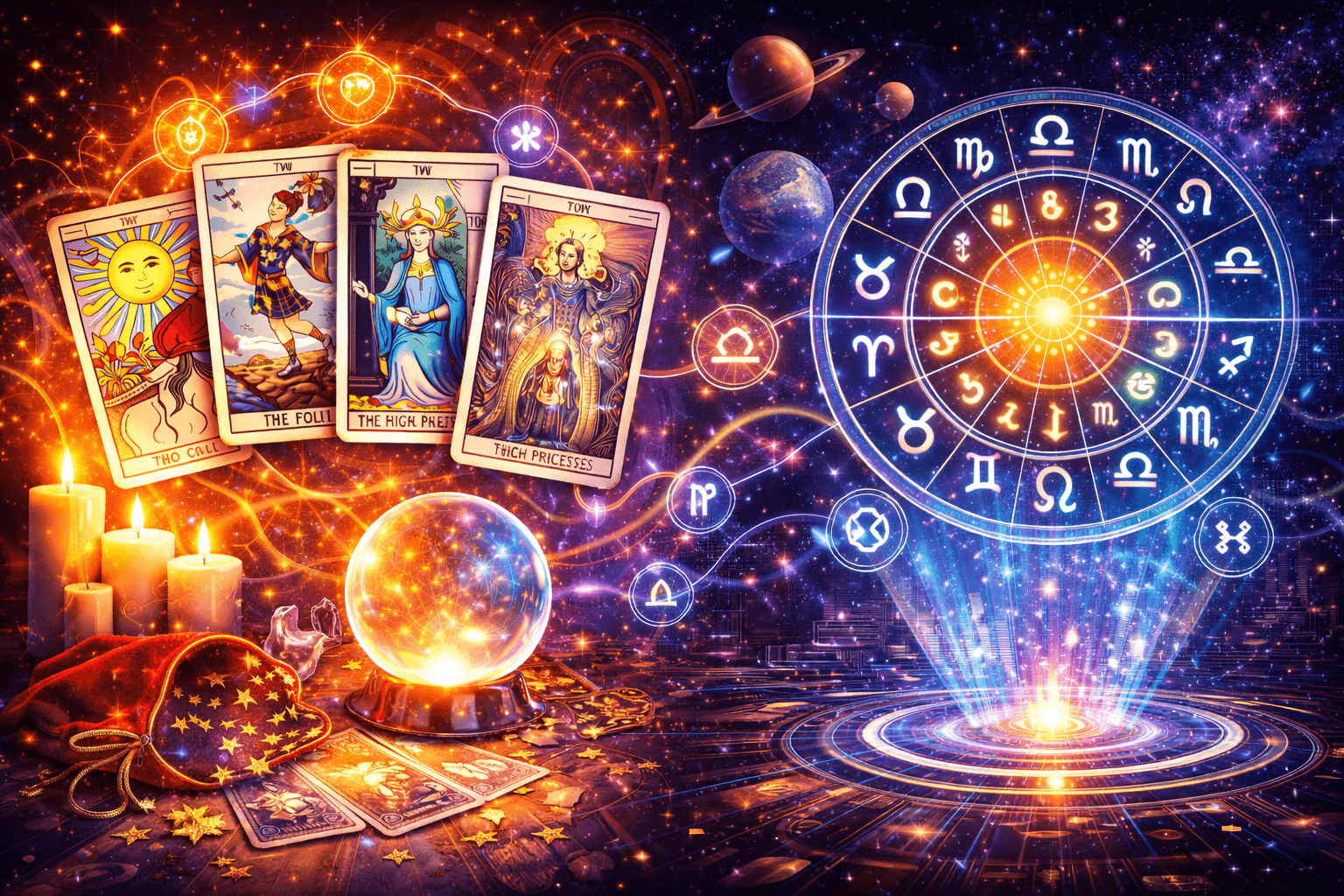
Here's what most "tarot vs astrology" articles miss: these two systems aren't just compatible — they're deeply structurally connected. Tarot was historically developed in close relationship with astrological symbolism, and the connections between them are woven into the fabric of both practices.
The Major Arcana and the Planets
Each of the 22 Major Arcana cards corresponds to either a planet or a zodiac sign in traditional astrological symbolism:
- The Sun — the Sun card, representing vitality, identity, and creative life force
- The Moon — the Moon card, representing intuition, the unconscious, and emotional cycles
- The Tower — Mars, representing sudden force, disruption, and transformation through impact
- The Empress — Venus, representing abundance, beauty, sensuality, and creative fertility
- The Hierophant — Taurus, representing tradition, structure, and established wisdom
- The Emperor — Aries, representing leadership, assertion, and the initiating force
- The Hermit — Virgo, representing discernment, withdrawal, and inner illumination
- The Wheel of Fortune — Jupiter, representing expansion, cycles, and the turning of fate
- The World — Saturn, representing completion, mastery, and the successful conclusion of a major cycle
These aren't arbitrary associations. They reflect a shared symbolic language developed across centuries of Western esoteric tradition in which astrology and tarot were understood as two expressions of the same underlying cosmology.
The Minor Arcana and the Four Elements
The four suits of the Minor Arcana map directly onto the four astrological elements:
- Wands correspond to Fire — Aries, Leo, Sagittarius
- Cups correspond to Water — Cancer, Scorpio, Pisces
- Swords correspond to Air — Gemini, Libra, Aquarius
- Pentacles correspond to Earth — Taurus, Virgo, Capricorn
If you know your natal chart, you can use this correspondence to understand which suit of the Minor Arcana is most likely to resonate with your Sun, Moon, or Rising sign — and which life domains (as described by each suit) connect most directly to your elemental emphasis.
Timing With Both Systems
One of the most practically useful connections between tarot and astrology is timing. Astrology tells you when a particular energy is active — Saturn transiting your 4th house over the next two years brings themes of home, roots, and foundational restructuring into focus. Tarot can then help you navigate how to engage with that energy — what the specific texture of your experience is right now, what you're being asked to look at, and what action might serve you in this chapter.
The combination of astrology's long view with tarot's present-moment precision is genuinely more useful than either practice alone. Astrology without tarot can feel abstract — you understand the chapter you're in but not how to navigate this particular week. Tarot without astrology can feel unanchored — you understand the immediate moment but lack the context of what larger cycle you're moving through.
Tarot vs Astrology: Which Is More Accurate?
Neither tarot nor astrology is more accurate than the other — they're measuring different things. Astrology is more precise for understanding your personality structure, identifying life timing cycles, and knowing when particular themes become active. Tarot is more immediate and responsive for understanding present situations, clarifying decisions, and exploring what you may not be consciously aware of.
This is one of the most commonly searched questions about these two practices, and it deserves a direct answer rather than a diplomatic non-answer.
Astrology has an objective accuracy advantage in chart calculation — your planetary positions are astronomically verifiable, and a well-made birth chart is genuinely accurate in the sense that it correctly maps the sky at your birth. Its interpretive framework has been developed and refined over thousands of years of observation and tradition.
Tarot's "accuracy" is a different kind of question. The cards drawn in any reading are random in the mechanical sense. Whether they're meaningful depends on your philosophical framework — whether you believe in synchronicity, intuition as a real informational channel, or the symbolic resonance of archetypal imagery with lived human experience. Many people — including plenty of skeptics who approach it with scepticism — report tarot readings as surprisingly resonant and useful for clarifying their own thinking.
The most honest answer is that both systems are frameworks for self-reflection rather than predictive machines. Their accuracy is best measured not by whether they predict specific events, but by whether they help you understand yourself more clearly, make decisions with greater awareness, and navigate your life with more intentionality. By that measure, both — used thoughtfully — can be genuinely valuable.
Which Should You Start With?
If you're drawn to structure, pattern, and understanding your deep personality and life timing, start with astrology. If you're drawn to intuition, immediate guidance, and exploring specific present-moment questions, start with tarot. If you're genuinely curious about both, astrology gives you a foundation that makes tarot richer — but either works as an entry point.
Here's a practical breakdown of who tends to connect most naturally with each:
Start with astrology if:
- You want to understand your personality at a foundational level
- You're interested in timing — knowing what cycles are active and when
- You enjoy working with structured systems and precise data
- You want a stable framework you can deepen your knowledge of over years
- You're curious about how your chart describes your relationship patterns, career drives, and life purpose
Start with tarot if:
- You want immediate, responsive guidance for a specific question or situation
- You're drawn to imagery, symbolism, and intuitive interpretation
- You prefer a practice that's accessible without requiring significant background knowledge
- You want something you can pick up and use meaningfully within days
- You're going through a specific decision or life moment and want a reflective tool
Start with both if:
- You're naturally curious about the esoteric and want the most complete picture
- You're willing to invest time in learning two interconnected systems
- You want to eventually understand how the astrological correspondences within tarot deepen both practices.
How to Use Tarot and Astrology Together
The most powerful way to engage with either practice is to use them in concert. Here are three specific ways to combine them:
1. Use Astrology to Set Context, Tarot to Navigate It
When you know a significant transit is active — Saturn crossing your Ascendant, a solar eclipse in your 7th house, Jupiter entering your 10th — pull a tarot card to ask what this transit is asking of you specifically right now. The astrological context tells you the chapter; the card tells you the page you're on today.
2. Pull Cards for Your Natal Chart Placements
A powerful self-knowledge exercise: pull one tarot card for each of your Big Three — your Sun sign, Moon sign, and Rising sign — and ask what each placement is asking you to develop right now. The card that appears for your Moon in Scorpio might reveal what your emotional patterns are specifically calling for in this period of your life.
3. Time Your Readings With the Moon Cycle
The Moon moves through all twelve zodiac signs over the course of a month, spending roughly two and a half days in each. Pulling tarot cards aligned with the Moon's current sign — drawing Cups-heavy questions during Water sign Moons, Swords questions during Air sign Moons — creates a natural rhythm that many practitioners find significantly deepens the quality and relevance of their readings.
Using Both Practices Together With Aurae
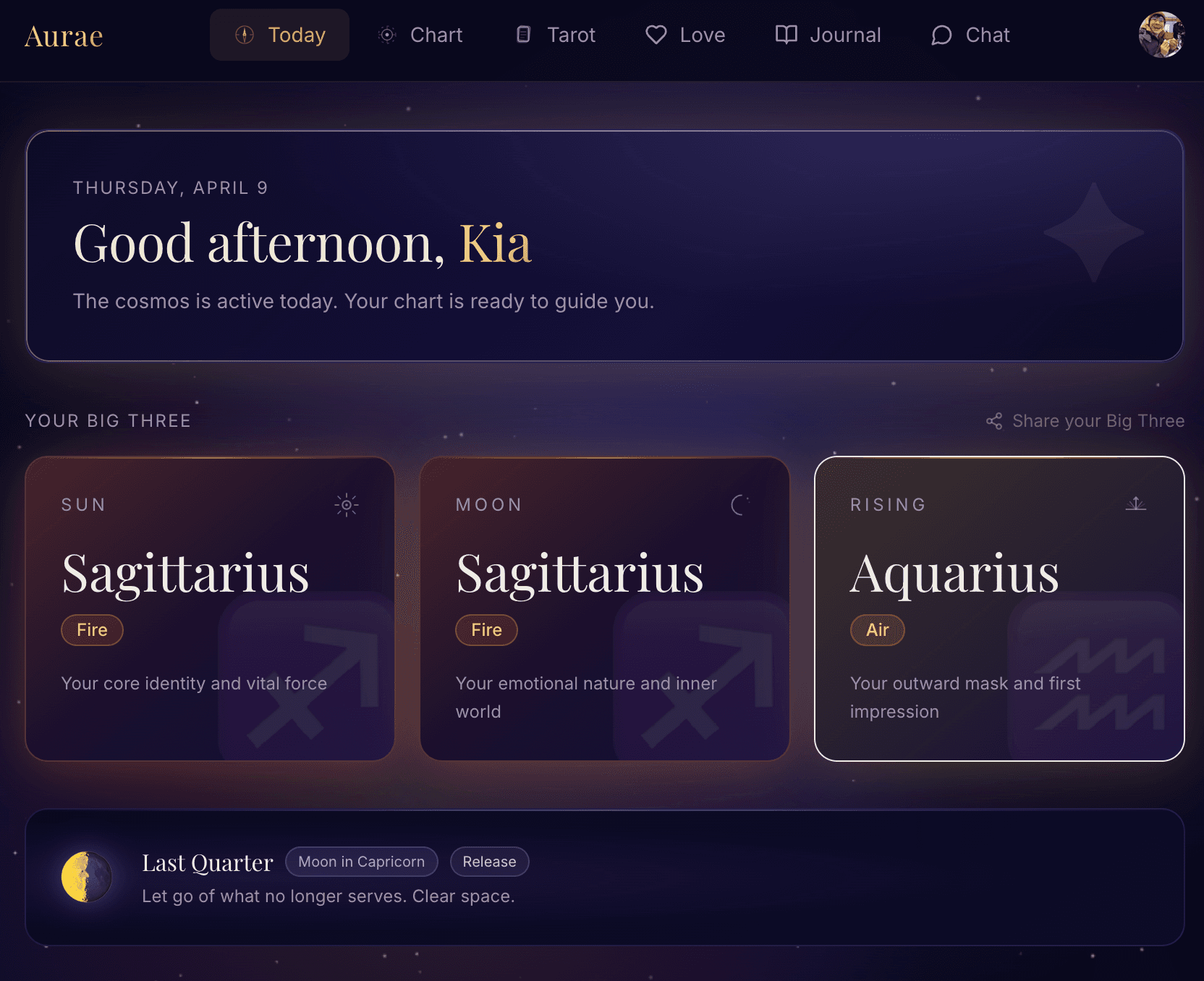
One of the reasons Aurae Astrology was built the way it was is precisely this insight: tarot and astrology aren't separate practices to manage across multiple apps. They're complementary systems that are more powerful together than apart.
Aurae brings them into a single, coherent platform — your full natal chart and AI-powered birth chart interpretation sit alongside daily tarot readings that are contextualised within current astrological weather. When Mercury is retrograde, your tarot interpretation reflects it. When your Sun is in a challenging transit, the daily card speaks to that energy. The two systems are integrated rather than siloed, which is how serious practitioners have always worked with them.
Try Aurae free at auraeastrology.com →
Frequently Asked Questions
What is the difference between tarot and astrology? Astrology uses precise astronomical data — your birth date, time, and location — to generate a fixed natal chart that maps your personality and life timing. Tarot uses a 78-card deck whose cards are drawn in response to a specific question, offering present-moment guidance through symbolic imagery. Astrology is structural and longitudinal; tarot is intuitive and immediate.
Which is more accurate — tarot or astrology? Neither is definitively more accurate — they measure different things. Astrology is more precise for personality analysis and life timing cycles, grounded in verifiable astronomical data. Tarot is more responsive for present-moment guidance and decision clarity, working through symbolic resonance and intuitive interpretation. Most experienced practitioners consider them complementary rather than competitive.
Is tarot connected to astrology? Yes — deeply. Each of the 22 Major Arcana cards corresponds to a planet or zodiac sign in traditional Western esoteric symbolism. The four Minor Arcana suits map directly onto the four astrological elements (Wands/Fire, Cups/Water, Swords/Air, Pentacles/Earth). Tarot and astrology were developed within the same tradition and share a common symbolic framework.
Can you use tarot and astrology together? Absolutely — and many practitioners consider this the most powerful way to work with both. Astrology provides the macro context: what chapter of life you're in, what themes are active, what long-term cycles are at play. Tarot provides the micro navigation: what's happening right now, what to pay attention to, what the present moment is asking of you.
Which should I learn first — tarot or astrology? There's no universally right answer. Astrology offers a structured foundation that makes tarot's astrological correspondences richer once you learn it. Tarot is arguably more immediately accessible — you can draw meaningful cards within days of starting, while astrology takes longer to develop working knowledge. Many practitioners recommend starting with whichever system you're drawn to first and letting curiosity lead.
Do I need to believe in astrology or tarot for them to be useful? Not necessarily. Both systems function as frameworks for self-reflection and pattern recognition regardless of your metaphysical beliefs. Many users engage with them psychologically — as structured tools for exploring their own thoughts, patterns, and decisions — rather than as literal predictive mechanisms. The question worth asking is not "is this literally true?" but "is this useful for helping me understand myself and my situation more clearly?"
Are tarot cards based on zodiac signs? Each tarot card has astrological correspondences — Major Arcana cards are linked to planets and zodiac signs, and the four Minor Arcana suits correspond to the four astrological elements. However, tarot readings are not organised by your zodiac sign the way a horoscope is. The cards drawn in any reading respond to your question and present-moment energy rather than your Sun sign.
Tags: tarot vs astrology, difference between tarot and astrology, tarot and astrology together, tarot birth chart, astrology and tarot connection, major arcana astrology, how to use tarot and astrology, Aurae Astrology
Schema note for dev team: Implement Article and FAQPage schema. Target featured snippet for "What is the difference between tarot and astrology?" with the direct answer in the Quick Answer box at the top. Target "Which is more accurate, tarot or astrology?" as a secondary featured snippet from the dedicated section.