Tarot Cards for Zodiac Signs: The Complete Guide
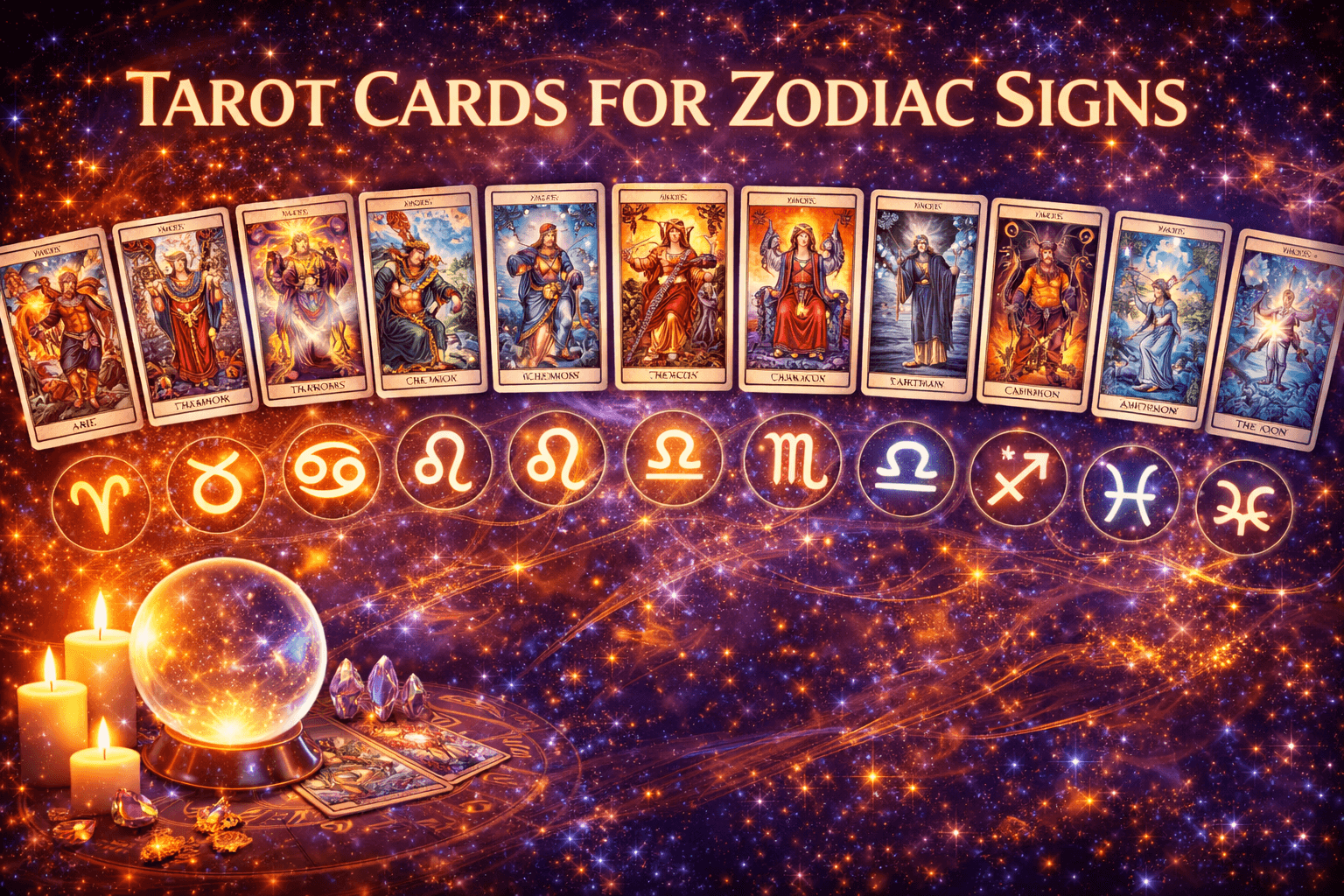
Every zodiac sign has a corresponding Major Arcana tarot card rooted in centuries of Western esoteric tradition. Aries is The Emperor, Taurus is The Hierophant, Gemini is The Lovers, Cancer is The Chariot, Leo is Strength, Virgo is The Hermit, Libra is Justice, Scorpio is Death, Sagittarius is Temperance, Capricorn is The Devil, Aquarius is The Star, and Pisces is The Moon. Read on for the full symbolic reasoning behind each connection — and how to actually use yours.
By the Aurae Astrology Team · 13 min read · Updated March 2026
Quick answer: Every zodiac sign has a corresponding Major Arcana tarot card rooted in centuries of Western esoteric tradition. Aries is The Emperor, Taurus is The Hierophant, Gemini is The Lovers, Cancer is The Chariot, Leo is Strength, Virgo is The Hermit, Libra is Justice, Scorpio is Death, Sagittarius is Temperance, Capricorn is The Devil, Aquarius is The Star, and Pisces is The Moon. Read on for the full symbolic reasoning behind each connection — and how to actually use yours.
How Tarot and Astrology Are Connected
Tarot and astrology share a deep symbolic framework developed across centuries of Western esoteric tradition. The twelve zodiac signs each correspond to one of the Major Arcana cards, the four tarot suits correspond to the four astrological elements, and the ten planetary rulers of the zodiac are represented throughout the deck — making the two systems genuinely interwoven rather than superficially parallel.
Most people discover their zodiac tarot card through a list without any explanation of why that particular card belongs to their sign. That's a significant loss, because the reasoning behind each correspondence is genuinely illuminating — and understanding it transforms your zodiac card from a fun piece of trivia into a meaningful lens for self-understanding.
The correspondences in this guide follow the system established by the Hermetic Order of the Golden Dawn, a British esoteric order founded in 1888 whose members — including the poet W.B. Yeats and occultist Aleister Crowley — synthesised Kabbalistic, astrological, and Egyptian symbolism into a unified framework. Their most lasting contribution to modern tarot practice was assigning each of the 78 cards a precise astrological attribution: a zodiac sign, a planet, or an element. As tarot historian Mary K. Greer documents, these attributions were the result of an intense late-Victorian race among French and British ceremonial magicians to decode the "real" correspondence between tarot and the Hebrew alphabet, astrological signs, and numbers.
Two of the Golden Dawn's most significant members — occultist A.E. Waite and artist Pamela Colman Smith — went on to create what remains the most widely used tarot deck in the world. First published in 1909 by William Rider & Son, the Rider-Waite-Smith deck has sold an estimated 100 million copies across more than 20 countries and set the template for virtually every modern deck that followed. As Artnet News reports, Smith's imagery — created in just six months under Waite's direction — became so synonymous with tarot itself that her contribution went largely uncredited for over a century, with the deck known simply as "Rider-Waite" until the tarot community began correcting the record. The Victoria & Albert Museum, which holds a set in its collection, notes that the cards combine symbolism from Christianity, Judaism, Egyptian mythology, alchemy, and astrology — a deliberate synthesis of the Golden Dawn's unified esoteric system.
A key principle of this framework: the Major Arcana represents archetypal forces and significant life themes. When a zodiac sign is assigned a Major Arcana card, it means that card's archetypal energy expresses the deepest qualities of that sign — not just its surface personality traits, but its underlying psychological and spiritual themes. As David Cunliffe's comprehensive Golden Dawn correspondence resource documents, 12 of the 22 Major Arcana cards correspond to zodiac signs, 7 to classical planets, and 3 to elements — a structured system, not an arbitrary list.
The Major Arcana Cards for Each Zodiac Sign
♈ Aries — The Emperor (Card IV)
Core themes: Authority, structure, leadership, the assertion of will
The Emperor is the zodiac's natural pioneer matched with the tarot's archetype of decisive authority — and the correspondence is immediately intuitive. Aries is the first sign of the zodiac, initiating the astrological year with bold, forward-driving energy. The Emperor sits on his throne not through inheritance but through the force of his will and the clarity of his vision. He builds structure from nothing, takes decisive action, and leads from the front.
Both Aries and The Emperor carry the energy of Mars — the planet of drive, assertion, and the initiation of action. Neither is passive. Neither waits for permission. The Emperor's throne is carved from stone, but he built it himself — which is exactly the Aries archetype expressed in its highest form.
The shadow of this correspondence is worth noting too: The Emperor can become rigid, controlling, and unwilling to adapt. For Aries, this manifests as impulsiveness hardening into stubbornness — the pioneer who refuses to course-correct. The Emperor asks Aries to channel their initiating fire into structures that last, rather than burning bright and moving on before anything is built.
What this card asks of Aries: To lead with vision rather than impulse — to build something lasting rather than simply being first.
♉ Taurus — The Hierophant (Card V)
Core themes: Tradition, wisdom, embodied knowledge, the value of the established
The Hierophant is the bridge between the sacred and the earthly — a figure who has accumulated wisdom through long commitment to established systems and passes that knowledge to others through tradition and practice. Taurus, ruled by Venus and grounded in the fixed earth element, relates to the world through the body, the senses, and the accumulated value of what is known and trusted.
The correspondence speaks to Taurus's deep relationship with continuity and the wisdom embedded in established ways of living. The Hierophant doesn't innovate — he safeguards. Taurus doesn't seek novelty — they deepen. Both the card and the sign understand that real value is built slowly, through consistency, and that the traditions inherited from those who came before contain compressed wisdom worth preserving.
The Hierophant also represents the teacher and spiritual guide — which connects to Taurus's gift for embodied wisdom. Taurus knows things through the body, through repetition, through the patient accumulation of experience that turns into genuine expertise.
What this card asks of Taurus: To distinguish between tradition worth preserving and convention worth questioning — and to share their hard-won embodied wisdom rather than keeping it private.
♊ Gemini — The Lovers (Card VI)
Core themes: Choice, duality, connection, the integration of opposites
The Lovers is frequently misread as simply a romantic card, but its deeper meaning — and its correspondence to Gemini — is about the fundamental human experience of duality and the choices that arise from it. Gemini is the sign of the Twins, perpetually navigating two sides of every experience, two possible perspectives, two potential paths. The Lovers card depicts precisely this: a moment of significant choice between two possibilities, with both the divine and the earthly present in the scene.
Ruled by Mercury — the planet of communication, thought, and the movement between different realms — Gemini experiences the world through the tension of opposing ideas held simultaneously. The Lovers card captures that tension: not the comfortable unity of having chosen, but the charged moment of genuine choice between two genuine possibilities.
The card also speaks to Gemini's great gift: the ability to connect. The Lovers card is fundamentally about relationship — the moment when two separate things come into contact and create something new between them. Gemini's native intelligence is relational, finding meaning in the space between different perspectives.
What this card asks of Gemini: To make genuine choices rather than remaining perpetually between options — and to understand that real connection requires commitment as well as curiosity.
♋ Cancer — The Chariot (Card VII)
Core themes: Directed will, emotional mastery, achieving goals through inner strength
The Chariot is a card of triumphant forward movement — but look closely at most depictions: the charioteer holds no reins. They guide two sphinxes, often of opposing colours (representing opposing forces), through the sheer force of their concentrated will rather than through physical constraint. This is the perfect emblem of Cancer's deepest challenge and greatest strength.
Cancer is a water sign — deeply emotional, powerfully intuitive, strongly pulled toward home and security. On the surface, the bold Chariot seems an unlikely match for the sensitive Crab. But Cancer's defining quality is not sensitivity — it's the extraordinary inner strength that lies beneath that sensitivity. The shell of the Crab exists precisely because what's inside is so tender and vital. The Chariot is that inner strength in action: the ability to move powerfully through the world while holding contradictory emotional forces in check.
The Chariot is also associated with the home in an interesting way — the canopy above the charioteer echoes a protective shelter carried forward on the journey. Cancer doesn't leave home behind; Cancer brings home wherever they go.
What this card asks of Cancer: To trust that their emotional sensitivity is a source of navigational power rather than a vulnerability — and to move forward rather than retreating into the shell when the world feels overwhelming.
♌ Leo — Strength (Card VIII)
Core themes: Courage, gentle mastery, the integration of instinct and heart
Strength depicts a figure — usually a woman — gently closing the jaws of a lion. Not through force or fear, but through love and quiet confidence. The lion doesn't struggle. The figure doesn't strain. The mastery in this card is of the heart, not the will — which is precisely what Leo's ruling Sun and fixed fire nature calls for at its highest expression.
Leo is the sign of the lion — of creative fire, generous self-expression, and the genuine warmth that comes from a strong, secure solar identity. The easy reading of Leo emphasises drama, performance, and the desire for recognition. The Strength card points toward something more profound: the Leo who has moved through the need for external validation and found the deeper quiet confidence that comes from genuine self-knowledge and self-acceptance.
The lion in the Strength card is not defeated — it's met with such wholehearted love that it surrenders willingly. This is Leo's greatest gift when fully expressed: the warmth so genuine and consistent that it transforms what it touches without dominating it.
What this card asks of Leo: To lead with heart rather than performance — to discover that genuine strength is quiet and warm rather than loud and commanding.
♍ Virgo — The Hermit (Card IX)
Core themes: Inner wisdom, solitude, discernment, the light that illuminates rather than performs
The Hermit stands alone at the top of a mountain, holding a lantern in the darkness. He does not shine the light on himself — he holds it out for others to find their way. This is Virgo expressed at its most essential: the wisdom accumulated through careful observation and dedicated practice, offered in service rather than kept for personal glory.
Virgo is the sign of discernment, analysis, and devoted service. Ruled by Mercury — which gives Virgo its penetrating analytical intelligence — this earth sign processes the world through careful attention to detail and a genuine desire to be useful. The Hermit's mountain represents the work of accumulation: you reach that height through sustained effort, not shortcuts.
The lantern is significant. It contains a six-pointed star — a symbol of the integration of opposites (the upward and downward triangles) that represents the practical wisdom Virgo seeks: the ability to see clearly without illusion, to discern what is true from what is comfortable, and to offer that clarity to others in useful rather than critical ways.
What this card asks of Virgo: To share their illuminating intelligence without retreating entirely into isolation — and to apply their discernment with compassion rather than perfectionism.
♎ Libra — Justice (Card XI)
Core themes: Truth, balance, the weighing of evidence, cause and effect
Justice holds the scales — Libra's own symbol — and a sword. The scales represent the careful consideration of all sides before reaching a verdict. The sword represents the clarity and decisiveness that must follow genuine deliberation. Together they capture both Libra's great gift and its central challenge.
Libra is the sign of balance, beauty, relationship, and the pursuit of fairness. Ruled by Venus, it seeks harmony and is genuinely skilled at seeing all sides of a situation. The Justice card honours this gift while pointing toward what must follow it: not perpetual deliberation, but the courage to make clear decisions after thorough consideration and to accept the consequences of those decisions with equanimity.
Justice in the tarot is not about emotion — it's about truth. The scales do not tip because someone is charming or because the outcome would be more comfortable. They tip where the weight of reality actually falls. For Libra, this is both a comfort and a challenge: the universe is more fair than daily experience suggests, but accessing that fairness requires setting aside the desire to please everyone in favour of the harder work of genuine truth-seeking.
What this card asks of Libra: To reach a decision rather than dwelling endlessly in deliberation — and to trust that genuine fairness requires clarity rather than accommodation.
♏ Scorpio — Death (Card XIII)
Core themes: Transformation, endings, the cycle of death and renewal, shedding what no longer serves
Of all the tarot correspondences, Scorpio and Death is the one most people already know — and the one most frequently misunderstood. The Death card almost never signifies physical death. It represents transformation: the ending of one form of being so that another can begin. The figure on the card rides through a landscape where some figures kneel in surrender while others resist — and the rider moves on regardless, because transformation cannot be bargained with.
Scorpio is the sign of transformation, depth, and the courageous engagement with what lies beneath the surface. Where other signs shy away from the shadow material — grief, loss, power, sexuality, death, the unconscious — Scorpio moves toward it with intense, investigative focus. Scorpio knows instinctively that what is buried does not disappear; it grows in the dark. The only path to genuine power is through, not around.
The Death card is, at its most essential, a card of courage — the willingness to let something end so that something new can be born. This is Scorpio's defining characteristic: the capacity to undergo profound transformation by choosing to release what has died rather than clinging to its form.
What this card asks of Scorpio: To distinguish between meaningful depth and attachment to intensity for its own sake — to let things end when they are complete, rather than holding on past the natural cycle.
♐ Sagittarius — Temperance (Card XIV)
Core themes: Integration, the long view, patience, the alchemy of combining opposites
Temperance depicts an angelic figure pouring liquid between two cups — one of gold, one of silver — in a perpetual, careful flow. Behind the figure is a path leading toward a distant crown on the horizon. The card speaks of the patient, intentional blending of opposites into something greater than either alone — and of keeping the distant goal in sight while tending carefully to the present work.
Sagittarius is the sign of the philosopher, the explorer, the seeker of meaning across vast distances of thought, geography, and experience. Ruled by Jupiter — the planet of expansion and the search for truth — Sagittarius is always oriented toward the horizon. The Temperance card honours this orientation while adding its essential counterweight: the patient, careful work of integration that turns experience into wisdom.
Sagittarius without Temperance is all arrow and no aim — firing enthusiastically in every direction without the sustained, careful attention that transforms enthusiasm into genuine understanding. Temperance asks Sagittarius to slow the perpetual forward momentum enough to integrate what has already been gathered, and to recognise that the crown on the horizon is reached by the long path, not the shortcut.
What this card asks of Sagittarius: To develop patience with the process of integration — and to understand that wisdom requires the sustained distillation of experience, not just its accumulation.
♑ Capricorn — The Devil (Card XV)
Core themes: Material attachment, the shadow, reclaiming power from what binds us
The Devil is the most misunderstood card in the Major Arcana, and its correspondence to Capricorn requires careful unpacking. The card depicts two figures chained to the Devil's pedestal — but look closely at most traditional depictions and the chains are loose. They could slip free at any moment. They remain because they have forgotten they can leave.
Capricorn is the sign of ambition, structure, mastery, and the long climb toward achievement. Ruled by Saturn — the planet of limitation, discipline, and earned reward — Capricorn understands that worthy goals require sustained, sometimes arduous effort. The shadow of this understanding is the risk of becoming so focused on the climb that the chains of obligation, status anxiety, material attachment, or the fear of failure become invisible. The Devil card doesn't represent evil — it represents the bondage of unconscious attachment.
For Capricorn, this correspondence is an invitation to examine what they are truly working toward and why. Not to abandon ambition — Capricorn's capacity for sustained, disciplined effort is one of the zodiac's greatest gifts — but to ensure that the structures they build serve genuine values rather than unconscious fears. The chains in The Devil card are loose. The recognition of that looseness is liberation.
What this card asks of Capricorn: To examine what they believe they cannot live without — and to distinguish between disciplined commitment to genuine values and unconscious servitude to status, fear, or material attachment.
♒ Aquarius — The Star (Card XVII)
Core themes: Hope, renewal, the vision of a better world, healing after darkness
The Star follows The Tower — the card of sudden collapse and disruption — in the Major Arcana sequence. After the lightning strikes and the structures fall, The Star appears: a figure kneeling by still water, pouring fluid from two jugs into the earth and the water, with a great star blazing above and seven smaller stars around it. It is a card of profound hope — not naive optimism, but the steady, luminous vision that persists after the worst has passed.
Aquarius is the sign of the visionary, the humanitarian, and the radical innovator. Ruled by Uranus — the planet of sudden change, disruption, and brilliant breakthrough — Aquarius carries the paradox of being both the most futuristic sign and one of the most idealistic. The Star captures exactly this: the ability to hold a clear, luminous vision of what could be, even after (or especially after) the current structures have proven inadequate.
The water poured into both the earth and the stream represents the Aquarian gift of grounding visionary ideas into the material world while keeping them in flow — the practical idealist who doesn't just dream of a better world but actively channels their vision into reality.
What this card asks of Aquarius: To pair their visionary capacity with enough groundedness to build lasting change — and to remain connected to individual human warmth rather than loving humanity in the abstract while struggling with the particular.
♓ Pisces — The Moon (Card XVIII)
Core themes: The unconscious, illusion, the liminal, the wisdom that lies beyond the rational
The Moon illuminates a path that winds between two towers, across water, past a crayfish emerging from the deep, toward a distant horizon. Everything in the card is suffused with silvery, uncertain light — beautiful but not fully clear. The Moon card speaks of the realm beyond rational understanding: the dream world, the unconscious, the intuitive knowledge that cannot be articulated but is nonetheless real.
Pisces is the final sign of the zodiac — the sign that contains and transcends all that came before. Ruled by Neptune, the planet of dissolution, mysticism, and the oceanic depths of the unconscious, Pisces navigates a world that other signs experience as overwhelming — the realm of feeling, intuition, imagination, and the blurred boundaries between self and other, present and past, waking and dream.
The Moon card does not offer certainty. It offers the wisdom of the liminal — the in-between spaces where the rational mind loses its footing and something deeper becomes available. For Pisces, this is native territory. The challenge the card presents is the same one Pisces faces: learning to trust the intuitive knowledge that lives in the moonlit world without losing the thread back to the shore.
What this card asks of Pisces: To trust their oceanic intuitive intelligence as a genuine form of knowing — and to develop enough discernment to distinguish between true intuition and wishful illusion.
The Minor Arcana and the Zodiac Elements
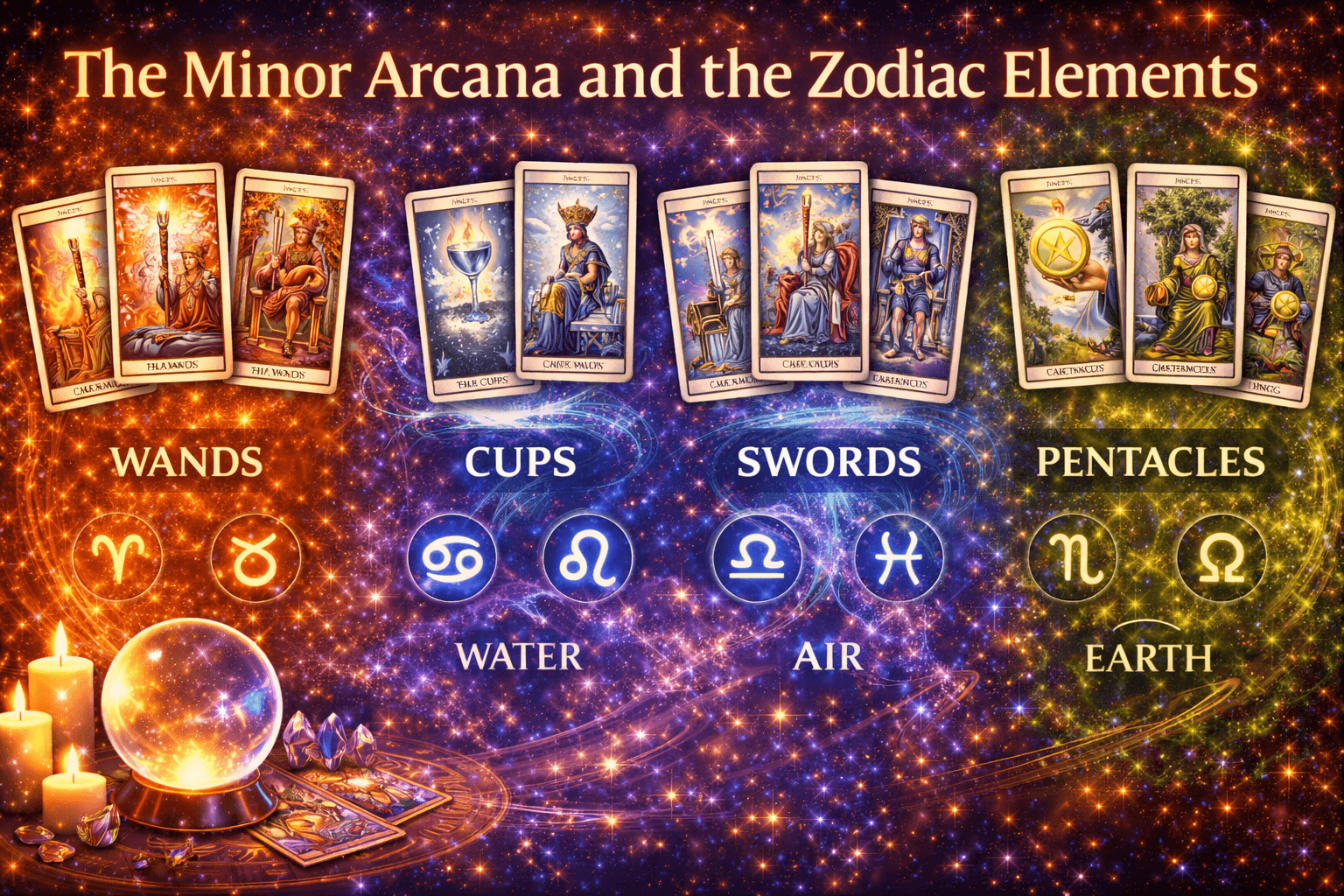
Beyond the Major Arcana correspondences, each zodiac sign connects to a tarot suit through its elemental association — opening up a much richer relationship between your sign and the full 78-card deck.
As Biddy Tarot explains in their comprehensive Minor Arcana guide, the four suits each represent a distinct domain of human experience: Cups govern feelings, emotions, intuition, and relationships. Pentacles govern finances, work, and the material world. Swords govern thoughts, communication, and decision-making. Wands govern energy, motivation, and creative passion.
These four suits map directly onto the four astrological elements, a connection that Wikipedia's Minor Arcana entry traces to the French occultists of the late 18th century who first formalised tarot's use as a divinatory system.
Fire Signs (Aries, Leo, Sagittarius) — Suit of Wands Wands represent passion, creative drive, ambition, and inspiration. According to Tarot.com's exploration of Minor Arcana numerology, the Wands illustrate "our soul's action, movement, and growth." Fire signs share these qualities naturally — when fire signs draw heavily from the Wands suit in a reading, those cards tend to resonate with particular immediacy.
Water Signs (Cancer, Scorpio, Pisces) — Suit of Cups Cups represent emotion, relationships, intuition, and the inner life. The Cups court cards — the Page, Knight, Queen, and King of Cups — often reflect water sign personalities with striking accuracy, particularly the Queen of Cups, widely associated with deep emotional intelligence and intuitive sensitivity.
Air Signs (Gemini, Libra, Aquarius) — Suit of Swords Swords represent thought, communication, conflict, and truth. As learntarot.com notes in their foundational lesson on the suits, Swords are the suit of "mental clarity" — the intellect at its most precise and decisive. Air signs live most naturally in the realm of ideas, and Swords readings tend to speak directly to their experience.
Earth Signs (Taurus, Virgo, Capricorn) — Suit of Pentacles Pentacles represent the material world — work, finances, physical health, and the patient building of lasting value. Earth signs are most at home in the tangible realm, and Pentacles readings engage the concerns that matter most to earth sign natives: security, craft, accumulated achievement, and embodied wellbeing.
Within each suit, as The Pagan Grimoire's detailed birth card guide explains, specific numbered cards are assigned to specific degrees and decans of the zodiac — a layer of correspondence developed from ancient Egyptian decan astronomy that was formalised by the Golden Dawn and is still used by professional practitioners today. This decan system is beyond the scope of most introductory guides, but knowing it exists gives a sense of just how thoroughly these two systems are interwoven at their foundations.
How to Use Your Zodiac Tarot Card
Knowing your zodiac tarot card opens up several genuinely useful practical applications beyond simply knowing which card is yours.
Use It as a Meditation Focus
Pull your zodiac card from the deck and spend five minutes sitting with it. Study the imagery closely — what do you notice that you hadn't seen before? What does the figure's posture, expression, or environment reflect about your own experience right now? Many practitioners find that their zodiac card surfaces different layers of meaning at different life stages, reflecting the card's qualities as they're currently being lived.
Pull It Intentionally Before a Reading
Before a general tarot reading, place your zodiac card face-up as an anchor. This establishes your personal energy as the context for the reading, and many practitioners find that the remaining cards they draw relate more clearly and specifically to their actual situation when their zodiac card is present as a ground.
Track When It Appears in Readings
When your zodiac card appears spontaneously in a reading — particularly in a significant position — pay close attention. Its appearance often signals that the themes of the card are particularly active in your life at this moment, or that the reading is touching something particularly close to your core nature.
Work With Its Shadow
Every Major Arcana card has a shadow dimension — the qualities of the archetype when it's distorted, blocked, or expressed unconsciously. Working with your zodiac card's shadow (through journaling, meditation, or simply honest reflection) can illuminate the patterns in your own psychology that most need attention.
Use It as a Daily Focus During Your Sun Season
During the weeks when the Sun moves through your zodiac sign — your solar season — working with your corresponding tarot card as a daily focus creates a powerful alignment between astrological and tarot energies. It's a way of consciously engaging with the archetype that your sign is most deeply associated with, during the period when that energy is most strongly activated.
Your Tarot Card and Your Full Birth Chart
Your Sun sign's tarot card is the most commonly referenced zodiac correspondence — but it's worth knowing that a complete astrological picture opens up far more nuanced tarot connections.
Your Moon sign has its own corresponding Major Arcana card — and since your Moon sign governs your emotional inner world, the Moon sign card often resonates even more personally and privately than the Sun sign card. Someone with a Scorpio Moon carries the energy of the Death card in their emotional and unconscious life, regardless of what their Sun sign is.
Your Rising sign has its corresponding card too — and since the Rising sign governs your outward presentation and the structure of your entire natal chart, this card speaks to how you engage with the world and what archetypal energy others first encounter in you.
A practitioner working deeply with the tarot-astrology connection might pull three cards simultaneously — their Sun sign card, Moon sign card, and Rising sign card — as a three-card spread that reflects the dynamic interaction of these three core dimensions of personality. The relationship between the three cards — whether they naturally harmonise or create tension with each other — can be remarkably revealing.
Knowing your full Big Three — Sun, Moon, and Rising — is essential for this kind of deeper work. If you haven't already calculated yours, Aurae Astrology calculates your complete natal chart and identifies all three placements instantly, free to start. Once you know your Moon and Rising signs, you can extend the zodiac tarot card framework into a genuinely rich personal practice.
Find your Big Three and your zodiac tarot cards at auraeastrology.com →
Frequently Asked Questions
What tarot card represents each zodiac sign? Each zodiac sign corresponds to one Major Arcana card: Aries — The Emperor, Taurus — The Hierophant, Gemini — The Lovers, Cancer — The Chariot, Leo — Strength, Virgo — The Hermit, Libra — Justice, Scorpio — Death, Sagittarius — Temperance, Capricorn — The Devil, Aquarius — The Star, Pisces — The Moon. These correspondences come from the Western esoteric tradition codified by the Hermetic Order of the Golden Dawn.
What is the tarot card for Scorpio? The tarot card for Scorpio is Death — card XIII of the Major Arcana. Despite its dramatic name, this card almost never signifies physical death. It represents profound transformation: the ending of one form of being so that another can emerge. This reflects Scorpio's defining quality — the capacity for deep psychological transformation through consciously releasing what has run its course.
What tarot card is Aries? The tarot card for Aries is The Emperor — card IV of the Major Arcana. The correspondence reflects their shared rulership by Mars and their shared archetype of decisive, initiating authority. The Emperor builds structures from the force of his will, leading from the front — which mirrors Aries' role as the zodiac's pioneer and initiating fire sign.
Why is Capricorn's tarot card The Devil? The Devil card represents unconscious attachment and the chains of material or psychological bondage — not evil. Its correspondence to Capricorn reflects the shadow of Capricorn's greatest strength: the capacity for sustained ambition can become unconscious servitude to status, fear, or material attachment. Importantly, the chains in most depictions of The Devil are loose — liberation comes from recognising they can be removed, not from external force.
Do I have more than one tarot card based on my zodiac sign? Your Sun sign gives you one Major Arcana card, but your Moon sign and Rising sign each have corresponding cards too — creating a more complete picture. Additionally, your elemental sign (Fire, Earth, Air, or Water) connects your entire chart to one of the four Minor Arcana suits. Many practitioners work with all three major cards — Sun, Moon, and Rising — together as a personalised three-card spread.
How are tarot cards connected to astrology? Tarot and astrology share a deep symbolic framework from Western esoteric tradition. The twelve zodiac signs each correspond to a Major Arcana card. The four tarot suits correspond to the four astrological elements. Individual tarot cards within each suit are assigned to specific degrees and decanates of the zodiac. The two systems were developed in close relationship and are most powerful when used together.
What is the tarot card for Pisces? The tarot card for Pisces is The Moon — card XVIII of the Major Arcana. The Moon card represents the unconscious, intuition, the liminal space between waking and dreaming, and the wisdom that lies beyond rational understanding. This reflects Pisces' deep connection to the unconscious, its fluid boundaries, its powerful intuition, and its native familiarity with the realm of dream, imagination, and spiritual depth.
What tarot card is Leo? Leo's tarot card is Strength — card VIII of the Major Arcana. The card depicts a figure gently mastering a lion through love and quiet confidence rather than force, reflecting Leo's deepest calling: not the performance of power, but the genuine inner strength that comes from a secure, warm-hearted solar identity. It speaks to the Leo who has moved beyond the need for external validation and found authentic self-expression.