Co-Star App Review 2026: An Astrologer's Honest Opinion
Is Co-Star actually accurate? A practicing astrologer gives a fair, detailed verdict on Co-Star's strengths, weaknesses, and who it's really built for in 2026.
By the Aurae Astrology Team · 10 min read · Updated March 2026
Quick verdict: Co-Star is the app that made astrology mainstream for a generation, and it deserves real credit for that. Its planetary data is solid, its design is iconic, and its social features are genuinely fun. But for users who've moved beyond the basics and want their chart to actually mean something, its shallow interpretations leave a significant gap.
What Is Co-Star?
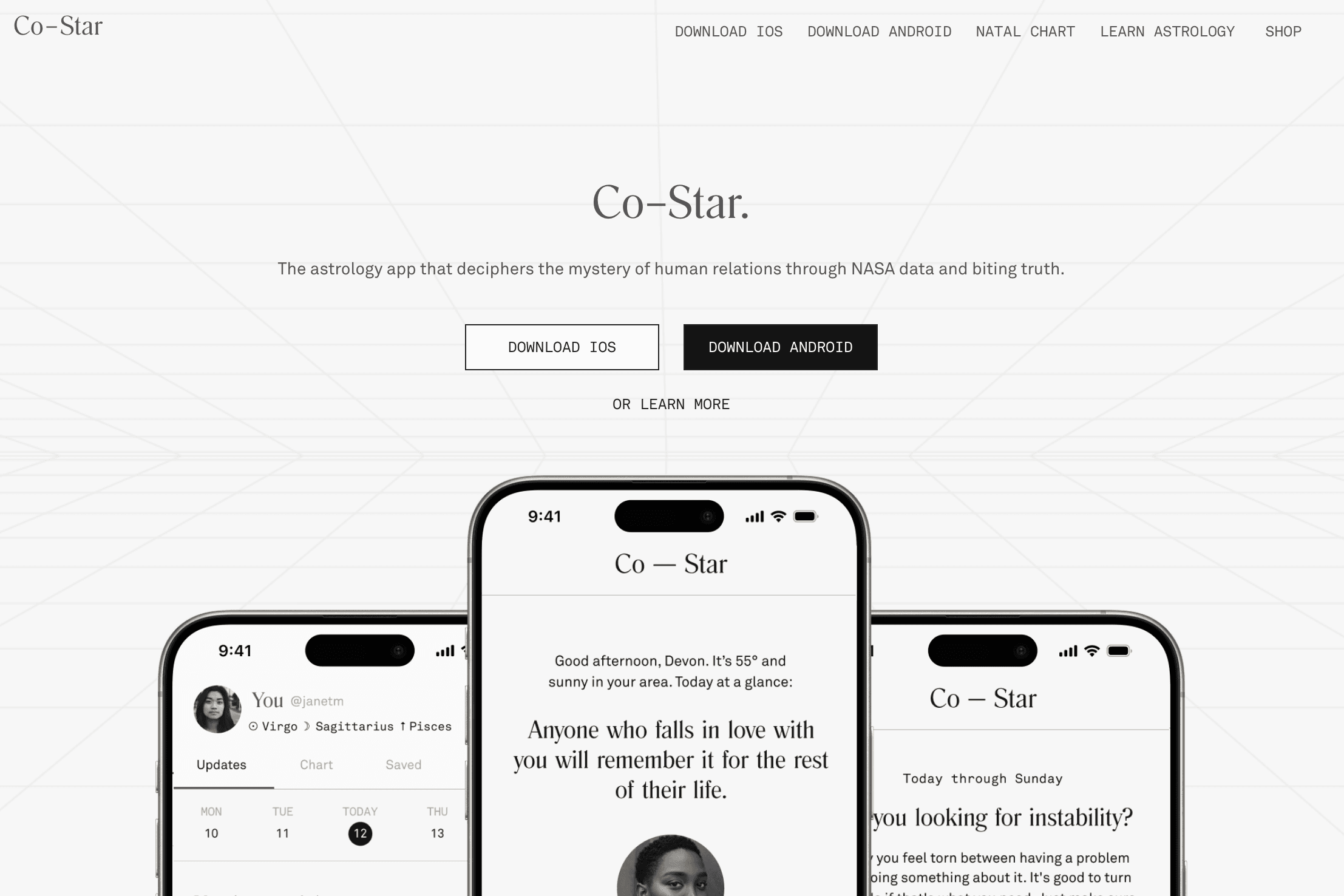
Taken from Co-Star website
Co-Star is a Western astrology app that generates personalised natal birth charts using real astronomical data and delivers AI-powered daily horoscopes, with a social layer that lets users compare charts with friends. It's available on iOS and Android, free to download, and has amassed over 30 million registered users since launching in 2017 — making it the most widely adopted astrology app among millennials and Gen Z in the Western market.
Co-Star was co-founded by Banu Guler and built with a deliberately stark, minimalist aesthetic — black background, white text, blunt language — that set it visually apart from the soft pastels and mystical imagery traditional to astrology content. That design choice was intentional and consequential: it helped position astrology as something intellectually credible and culturally current rather than fringe or superstitious.
For many people reading this, Co-Star was their first astrology app. That origin story matters when evaluating it honestly.
How Does Co-Star Work?
Co-Star works by calculating your full natal birth chart from your birth date, time, and location using NASA planetary data, then using AI to generate personalised daily horoscopes and compatibility insights based on your chart.
When you sign up, Co-Star asks for your birth information and generates your [natal chart [link: what-is-a-natal-chart]] — a map of where the planets were at the exact moment you were born. This chart forms the basis of all personalised content in the app.
Daily horoscopes are generated by Co-Star's AI system, which considers current planetary transits and how they interact with the placements in your birth chart. The app also allows you to add friends, compare charts, and receive compatibility breakdowns — the social feature that became Co-Star's most viral characteristic.
Push notifications arrive daily, ranging from the practical ("a good day to reach out to someone you've been avoiding") to the famously cryptic ("be the absence of want"). These notifications became cultural moments in their own right, regularly screenshotted and shared across social media.
What Co-Star Gets Right
1. The Planetary Calculations Are Solid
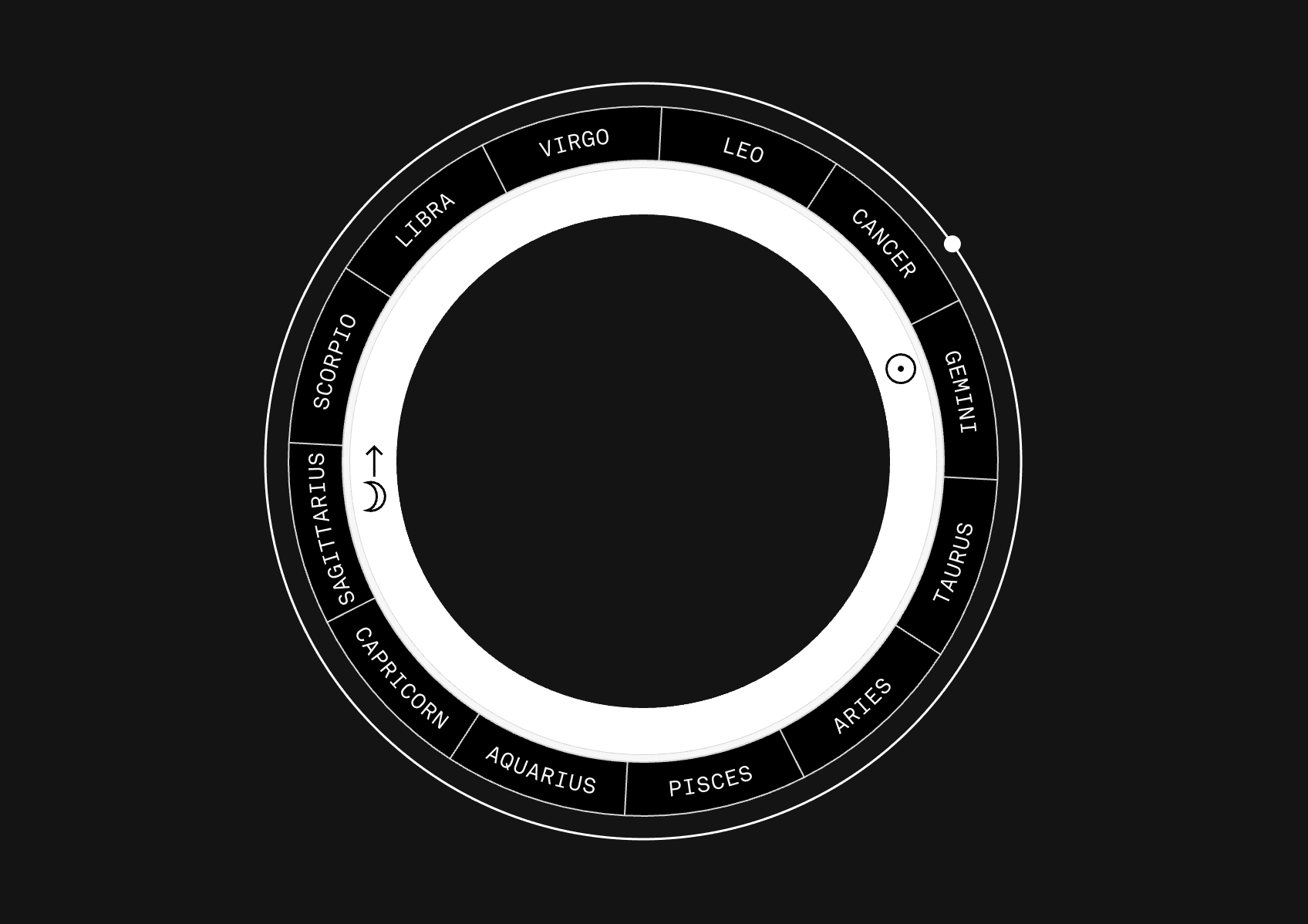
Co-Star uses NASA data to calculate planetary positions, and the resulting birth charts are astronomically accurate. Your Sun, Moon, Rising, and all ten planetary placements will be correctly calculated. For a free app, that accuracy baseline is meaningful — plenty of lower-quality competitors cut corners on the data that underpins everything else.
For users who want to verify their chart placements or cross-reference with other sources, Co-Star's calculations hold up reliably against professional-grade chart software.
2. The Design Remains Genuinely Iconic
Co-Star's stark black-and-white visual identity was radical when it launched and remains distinctive today. In a category prone to generic purple-and-gold mysticism aesthetics, Co-Star made an intentional choice to look like a serious, considered product. That choice resonated powerfully with younger audiences and played a significant role in destigmatising astrology as a cultural interest.
The typography is clean, the layout is purposeful, and the overall aesthetic communicates that this is an app built by people who care about craft. That still counts for something.
3. The Social Features Are the Best in the Category
No astrology app has cracked social features the way Co-Star has. The ability to add friends, view their charts, and receive side-by-side compatibility breakdowns is genuinely compelling — both as a product feature and as a social ritual. "What's your Co-Star?" became a real cultural shorthand in the same way "what's your sign?" was for previous generations.
The friend chart feature drives meaningful engagement and organic growth through sharing. From a product design standpoint it's one of the smartest decisions any astrology app has made, and no competitor has fully replicated its execution.
4. The Notifications Became a Cultural Phenomenon
Co-Star's push notifications — blunt, sometimes baffling, occasionally profound — became viral content in their own right. Whether that's a feature or a quirk is genuinely debatable, but the cultural footprint of "Co-Star told me to be the absence of want today" is undeniable. They made the app feel like a personality rather than a utility, which is harder to achieve than it sounds.
5. The Free Tier Is Genuinely Generous
Co-Star offers meaningful functionality without requiring payment — full birth chart, daily horoscopes, friend charts, and compatibility analysis are all available for free. In a category where aggressive paywalls have become common, that generosity is notable and contributes significantly to Co-Star's scale.
Where Co-Star Falls Short
1. The Interpretations Are Surface-Level
This is Co-Star's most significant limitation from an astrological standpoint, and it's worth being direct about. Co-Star's AI-generated daily readings focus primarily on the Big Three — Sun, Moon, and Rising — and treat the rest of your chart as secondary context at best. A [full natal chart [link: what-is-a-natal-chart]] contains ten planetary placements, twelve house positions, and dozens of aspects between planets, each carrying specific astrological meaning. Co-Star's interpretations engage with a fraction of that information.
The result is that daily readings, while pleasant, often feel generic enough to apply to a wide range of birth charts rather than uniquely to yours. Two people with very different charts but the same Rising sign will receive meaningfully similar guidance. That's not a minor limitation — personalisation is the entire point of birth chart astrology.
2. The Tone Can Be Alienating
Co-Star's deliberately blunt, sometimes nihilistic brand voice is a conscious creative choice, and for many users it's part of the appeal. But it's worth acknowledging that it doesn't work for everyone. Astrology at its most meaningful is a practice of self-compassion and empowerment — a tool for understanding your patterns, recognising your strengths, and navigating difficulty with greater self-awareness.
Co-Star's tone sometimes works against that. Notifications that emphasise limitation, ambiguity, or existential flatness can leave users feeling deflated rather than illuminated, particularly those engaging with astrology during difficult life periods. This isn't a universal criticism — plenty of users love exactly this quality — but it's a real consideration.
3. There's No Learning Curve or Growth Path
After a few weeks of regular use, most Co-Star users have seen essentially everything the app offers. There's no educational layer that deepens your understanding of your chart, no progression from beginner to more advanced astrological concepts, and no way to meaningfully explore why your chart says what it says. It's a loop rather than a journey.
For users who become genuinely curious about astrology — which Co-Star itself often sparks — the app offers nowhere to go. That curiosity ends up driving users to other apps, books, or practitioners rather than deeper into the Co-Star ecosystem.
4. Daily Readings Lack True Personalisation
Co-Star's daily content is primarily organised by the interaction between your Big Three and current transits — but the full picture of your [natal chart [link: what-is-a-natal-chart]] (intercepted houses, stellia, retrograde planets, chart rulers, and more) rarely features in the daily reading. The personalisation that does exist is real but limited, and experienced astrology students will notice the gap between what their chart contains and what Co-Star chooses to address.
5. No Tarot, No Rituals, No Wider Ecosystem
Co-Star does astrology — specifically, daily horoscopes and birth charts — and nothing else. There's no tarot integration, no moon ritual content, no wellness layer, and no educational resources. For users who experience astrology as part of a broader spiritual or self-care practice, Co-Star covers only one corner of that practice.
Co-Star Pricing
Co-Star is free to download and use, with the core features — birth chart, daily horoscopes, friend charts, and compatibility — available at no cost. A premium tier exists with additional features, though the free version is substantially functional.
This is genuinely one of Co-Star's competitive advantages. The free tier is more capable than most competitors' paid tiers in some respects, particularly around social and chart features.
Co-Star vs. Competitors
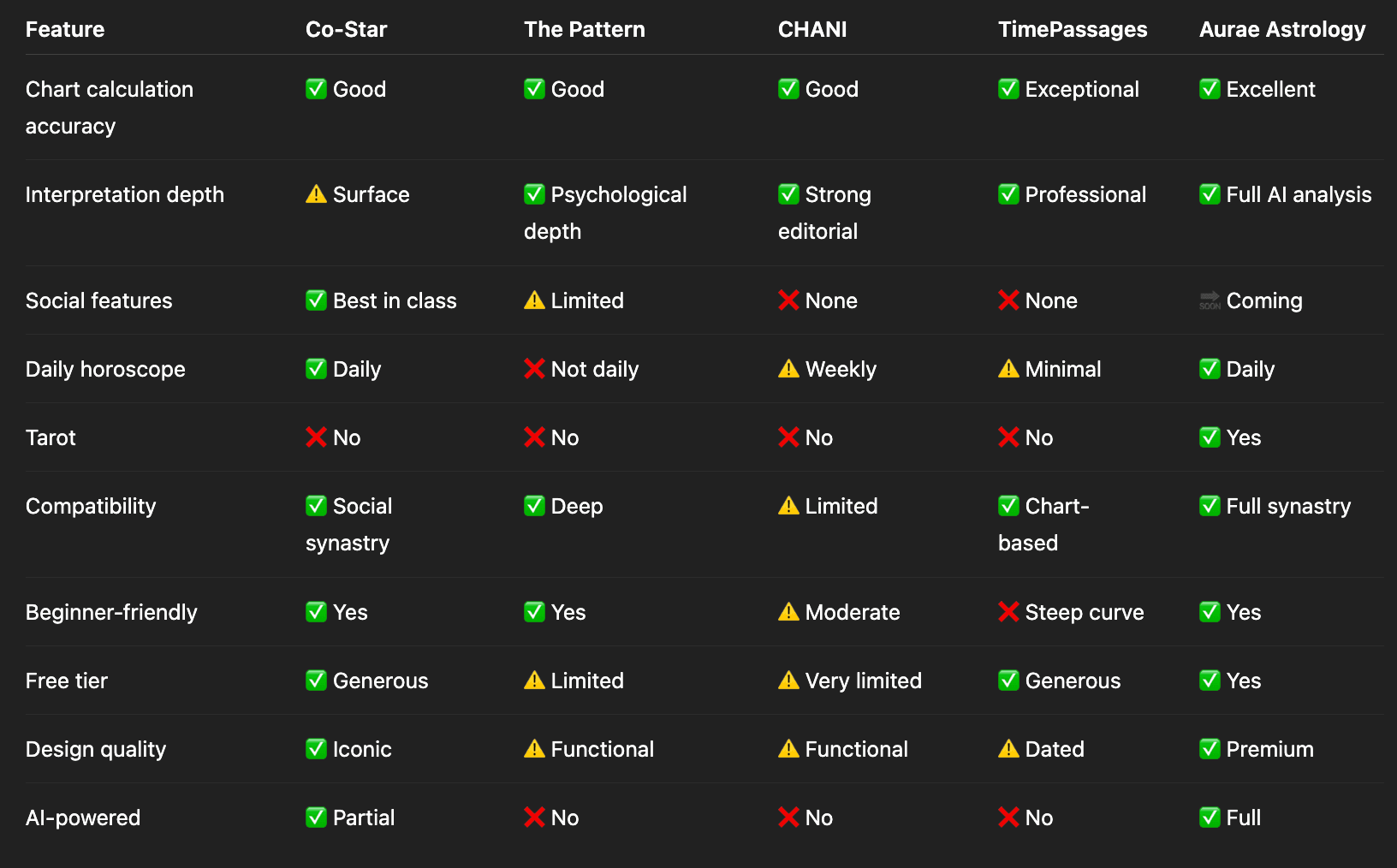
Who Is Co-Star Best For?
Co-Star is best for astrology beginners, social users, and anyone who wants a free, well-designed entry point into Western astrology — particularly those for whom chart comparison with friends is a meaningful part of the appeal.
It's less well-suited to users who want deep, genuinely personalised chart interpretation; those seeking educational astrological content; or practitioners who already have working astrological knowledge and want an app that honours that depth.
Co-Star excels as a gateway. Its limitation is that it doesn't grow with you.
Our Verdict
Rating: 3.5 / 5
Co-Star changed astrology's cultural footprint in ways that deserve genuine recognition. It brought millions of new people to the practice, made birth chart conversation mainstream, and demonstrated that astrology could be designed with the same care and intentionality as any other high-quality consumer product. That's a real legacy.
As a daily astrological companion for users who want depth, nuance, and genuine personalisation, it leaves meaningful ground uncovered. The Big Three focus, the limited interpretive range, and the absence of a growth path are real constraints — not fatal flaws, but honest limitations worth knowing before you commit.
If you're new to astrology, Co-Star is a perfectly good place to start. If you've been using it for a while and want more, that instinct is worth following.
Interested in Going Deeper Than Co-Star?
Co-Star's genius is accessibility — it makes astrology easy to get into. The gap it leaves is depth: what your full chart actually means, how your planetary aspects interact, and how current transits are specifically affecting your particular configuration.
Aurae Astrology is built around that next step — AI-powered interpretation of your complete natal chart across all ten planets, twelve houses, and major aspects, delivered daily in language that's both accessible and genuinely specific to your chart. Add tarot, compatibility synastry, and real-time sky tracking, all in an app designed with the same visual care Co-Star brought to the category. Free to start.
Both apps have genuine merit and serve different moments in someone's astrological journey. If Co-Star sparked your curiosity, Aurae is where that curiosity goes next.
Cast your chart free at auraeastrology.com →
Frequently Asked Questions
What is Co-Star? Co-Star is a Western astrology app that generates personalised natal birth charts using NASA planetary data and delivers AI-powered daily horoscopes. It's free to use and includes social features that allow users to compare charts with friends. It has over 30 million registered users worldwide.
Is Co-Star accurate? Co-Star's birth chart calculations are astronomically accurate, using real NASA data for planetary positions. Its AI-generated daily interpretations are considered surface-level by professional astrologers, as they focus primarily on Sun, Moon, and Rising signs rather than engaging with the full natal chart.
Is Co-Star free? Yes — Co-Star is free to download and use. The core features, including birth chart generation, daily horoscopes, friend charts, and compatibility analysis, are all available without payment. A premium tier with additional features is available for purchase.
Why are Co-Star notifications so strange? Co-Star's push notifications are deliberately blunt, cryptic, and sometimes abstract — a conscious brand choice designed to feel different from generic horoscope apps. The notifications range from practical advice to existential non-sequiturs. They became a viral cultural phenomenon, regularly shared on social media as a form of collective humour and reflection.
How does Co-Star generate horoscopes? Co-Star uses AI to generate daily horoscopes by analysing the interaction between your birth chart placements and current planetary transits. The system focuses primarily on your Sun, Moon, and Rising signs alongside real-time planetary positions to produce personalised daily guidance.
What is better than Co-Star? The best alternative to Co-Star depends on what you're looking for. For deeper psychological personality analysis, The Pattern is widely recommended. For professional-grade chart accuracy, TimePassages is the choice of practicing astrologers. For human-written editorial quality, CHANI is exceptional. For AI-powered full natal chart interpretation combined with daily horoscopes, tarot, and compatibility, Aurae Astrology is worth exploring.
Does Co-Star work for all zodiac signs? Yes — Co-Star generates personalised content for all twelve Western zodiac signs based on your full natal chart rather than just your Sun sign.
Is Co-Star available on Android? Yes, Co-Star is available on both iOS and Android devices.