CHANI App Review 2026: An Astrologer's Honest Opinion
Quick verdict: The CHANI app offers some of the finest human-written astrological content available on any platform, and its integration of astrology with mindfulness and ritual practice is genuinely thoughtful. The subscription cost, limited free tier, and slower content cadence are real trade-offs — but for users who prioritise quality over quantity, it frequently justifies every penny.
By the Aurae Astrology Team · 10 min read · Updated March 2026
Quick verdict: The CHANI app offers some of the finest human-written astrological content available on any platform, and its integration of astrology with mindfulness and ritual practice is genuinely thoughtful. The subscription cost, limited free tier, and slower content cadence are real trade-offs — but for users who prioritise quality over quantity, it frequently justifies every penny.
What Is the CHANI App?
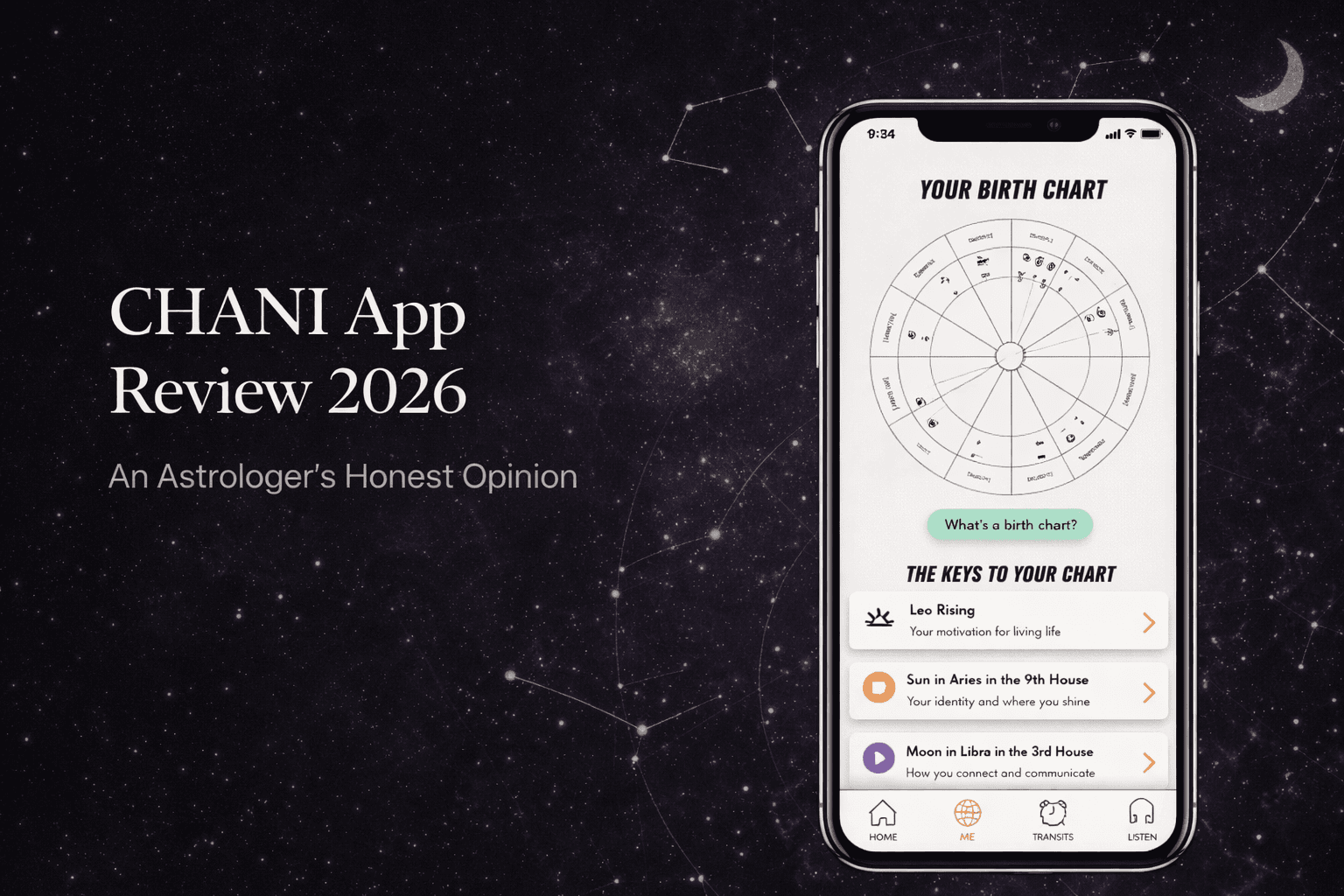
The CHANI app is a Western astrology and wellness application created by acclaimed astrologer and author Chani Nicholas. It offers birth chart readings, weekly horoscopes, new and full moon rituals, transit deep-dives, audio meditations, and workshop content — all written and recorded by Nicholas and her team of human astrologers, with no AI-generated content.
That last detail is the defining characteristic of the CHANI app in a market increasingly saturated with algorithmically generated horoscope content. CHANI Nicholas made a deliberate, public commitment to keeping the app entirely human-authored — a choice that shapes everything about what the app is, what it costs, and who it's best suited for.
Nicholas is one of the most respected voices in contemporary Western astrology. She is the author of You Were Born for This (a New York Times bestseller), has practiced astrology professionally for over two decades, and built a following for her writing long before the app existed. That credibility is the foundation the CHANI app is built on.
The app uses whole-sign houses — a traditional astrological house system — and is available on iOS and Android. A subscription is required for full access to its content.
How Does the CHANI App Work?
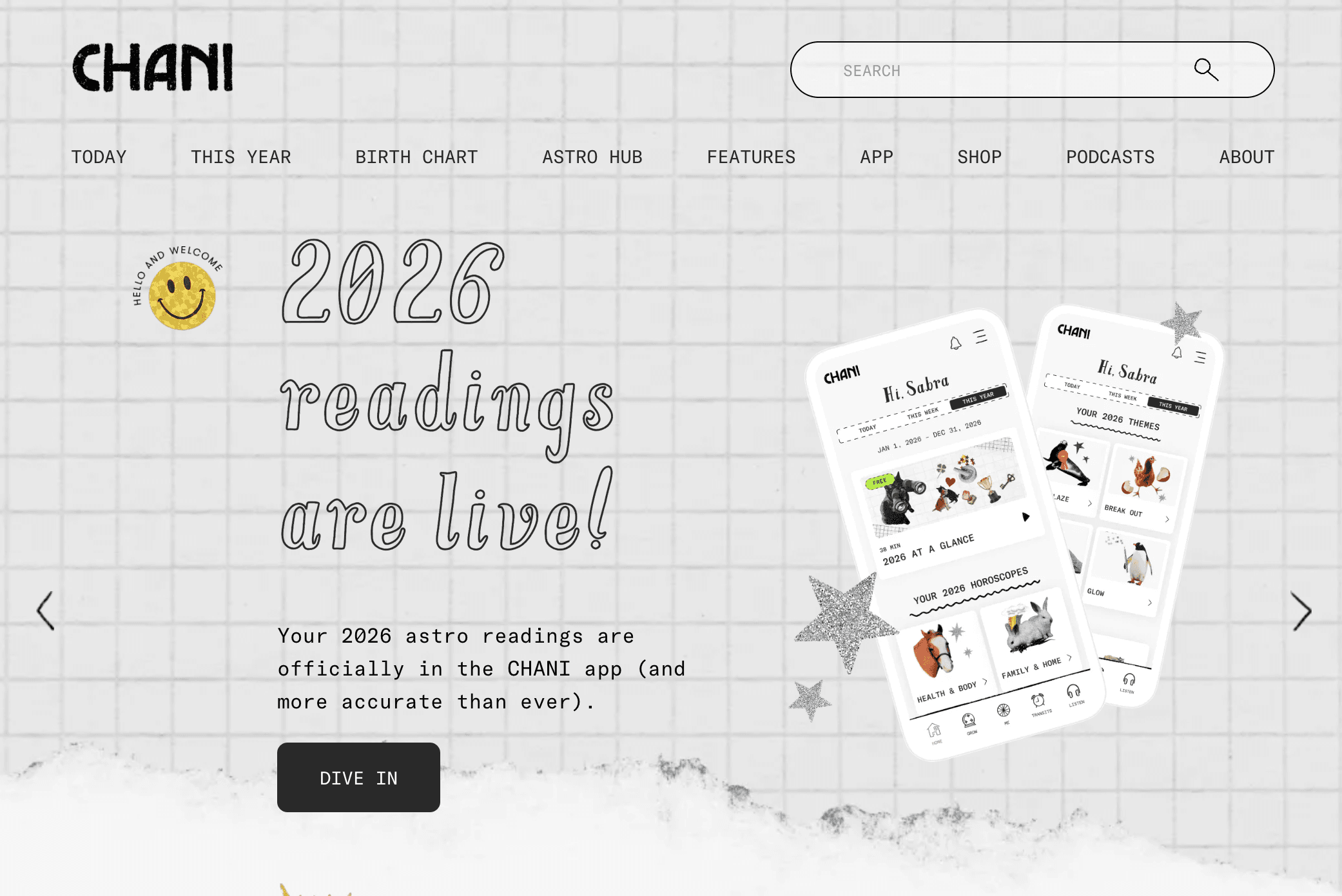
The CHANI app works by generating your natal birth chart from your birth date, time, and location, then delivering weekly horoscopes, moon cycle content, transit interpretations, and guided meditations organised primarily by your Rising sign — all written by human astrologers rather than generated by AI.
When you sign up, you enter your birth information and the app calculates your [natal chart [link: what-is-a-natal-chart]] using the whole-sign house system. Your Rising sign becomes the primary lens through which weekly content is organised — meaning the app treats your Rising sign as the most personally significant point in your chart, which aligns with traditional astrological practice and differs meaningfully from apps that prioritise your Sun sign.
Content is released on a weekly cycle tied to real astrological events. New moon and full moon cycles receive particular attention, with rituals, journal prompts, and reflective content released around each lunation. Transit deep-dives cover significant planetary movements — Saturn changing signs, eclipses, Venus retrograde — with the kind of detail and nuance that reflects genuine astrological expertise.
The app also includes audio content: meditations recorded by Nicholas and her team, tied to current astrological themes. These meditations have developed a devoted following among users who experience their astrology practice as part of a broader spiritual or mindfulness routine.
What CHANI Gets Right
1. The Writing Quality Sets the Standard for the Industry
It's difficult to overstate how much better CHANI's written content is than the algorithmic competition. Chani Nicholas is a gifted writer — her prose is precise, emotionally intelligent, and grounded in decades of lived astrological practice. The weekly horoscopes are substantive enough to read slowly and return to throughout the week. The transit deep-dives engage with genuine astrological complexity without becoming inaccessible. The moon ritual content is poetic without being vague.
For anyone who has grown frustrated with horoscope content that could apply to literally anyone on any day, CHANI is a genuine corrective. The writing knows what it's saying and why it's saying it — because a human astrologer wrote it with intention.
2. The Whole-Sign House System Is a Thoughtful Astrological Choice
Most mainstream astrology apps default to Placidus houses — a mathematically complex modern system that produces distorted results for people born at higher latitudes and that many traditional astrologers consider less historically grounded. CHANI's use of [whole-sign houses [link: whole-sign-houses-explained]] reflects a serious engagement with astrological tradition.
In whole-sign houses, each house corresponds exactly to one zodiac sign, beginning from your [Rising sign [link: what-is-a-rising-sign]]. The system is simpler, more historically rooted, and — many practitioners argue — more consistently accurate for personality and life circumstances analysis. For users whose chart readings have never quite resonated, switching to whole-sign houses (as CHANI uses) sometimes produces a significantly different and more coherent picture.
3. The Wellness Integration Is Genuinely Meaningful
CHANI doesn't treat astrology as a predictive tool alone — it treats it as a framework for intentional living. The new and full moon rituals in particular have developed a devoted following. These aren't vague suggestions to "set intentions" — they're structured, specific practices grounded in the astrological significance of each lunation, designed to help users engage actively with the energy of each cycle rather than just receive information about it.
The audio meditations add another layer to this integration. Tied to current planetary themes, they create a coherent practice rather than a passive consumption experience. This positions CHANI more as a spiritual companion than an information delivery system — a distinction that matters significantly to a meaningful portion of its audience.
4. Rising Sign Focus Reflects Real Astrological Practice
Most consumer astrology apps organise content by Sun sign — which is accessible and familiar but reflects a relatively shallow engagement with birth chart analysis. CHANI organises its content by Rising sign, which is how practicing astrologers typically read horoscopes. Your [Rising sign [link: what-is-a-rising-sign]] determines your house structure, which means Rising-sign-based horoscopes are significantly more accurate and personally relevant than Sun-sign equivalents.
This choice asks slightly more of users — you need to know your Rising sign, which requires knowing your birth time — but rewards that effort with content that's meaningfully more specific to your actual chart.
5. No AI Means No Astrological Errors
AI-generated astrology content can be fluent, coherent, and subtly wrong — conflating planetary meanings, generating plausible but astrologically incoherent interpretations, or producing content that sounds astrological without reflecting genuine astrological reasoning. This is a real and underappreciated problem with AI horoscope apps.
CHANI has none of this problem. Every piece of content reflects the deliberate intention of a human astrologer with a documented track record. When CHANI tells you what a Saturn transit to your natal Venus means, it draws on decades of traditional astrological knowledge rather than a language model's statistical approximation of that knowledge. For users who care about astrological accuracy, that difference is significant.
Where CHANI Falls Short
1. The Subscription Cost Is a Real Barrier
At approximately $14.99/month or $40/year, CHANI sits at the premium end of the astrology app market. The cost reflects the genuine expense of producing human-authored content at scale — good writers cost more than language models — and for users who engage deeply with the weekly content, moon rituals, and audio meditations, the value is clear. But for casual users who primarily want a free daily horoscope, the pricing feels steep compared to free alternatives that cover similar ground at a surface level.
It's also worth noting that the free tier is very limited — more of a preview than a functional free experience. Users who want to properly evaluate CHANI before subscribing have limited opportunity to do so without paying.
2. The Content Cadence Is Slow for Daily Users
Because every piece of content is human-written, CHANI produces significantly less volume than AI-powered competitors. The core content rhythm is weekly — a weekly horoscope, moon cycle content released around lunations, and occasional transit deep-dives for major astrological events. There is no AI available to generate on-demand readings, answer spontaneous questions, or produce fresh daily content for every day of the year.
For users accustomed to opening their astrology app every morning for a new daily reading, CHANI can feel quiet between its scheduled releases. This isn't a flaw so much as an inherent consequence of prioritising quality over volume — but it's worth knowing before subscribing.
3. Personalisation Has Meaningful Limits
While CHANI uses your full birth chart, its weekly content is organised by Rising sign — meaning you receive the same core weekly horoscope as everyone with your Rising sign, regardless of the specific planetary configurations elsewhere in your chart. A Scorpio Rising with Saturn conjunct their natal Moon in the 10th house receives the same Scorpio Rising weekly reading as a Scorpio Rising with an unaspected Saturn in the 6th.
For truly individualised interpretation — the kind that accounts for your specific planetary aspects, house placements, and chart configurations — you'd need a personal consultation with an astrologer. CHANI acknowledges this limitation implicitly by offering periodic workshop sessions alongside the app content.
4. The Interface Is Functional Rather Than Visually Ambitious
CHANI's design is clean and thoughtful but not visually distinctive. In a category where the aesthetic experience of the app contributes meaningfully to the overall practice — astrology is an emotionally resonant discipline, and the visual environment shapes engagement — CHANI's understated interface feels like a missed opportunity. Newer apps in the space have established a higher baseline for visual design, and CHANI hasn't fully kept pace.
5. Limited Compatibility Features
CHANI's compatibility content is significantly less developed than its horoscope and transit offerings. For users whose primary interest in astrology is relationship compatibility and synastry analysis, CHANI offers less than several competitors. This is an area where the constraints of human-authored content — you can't produce synastry analysis for every possible planetary combination — create a genuine functional gap.
CHANI App Pricing
The CHANI app costs approximately $14.99/month or $40/year. A very limited amount of free content is available without a subscription, but meaningful engagement with the app requires a paid plan.
There are no live astrologer session fees or additional in-app purchases beyond the subscription — everything within the subscription tier is included in that price. For users who subscribe annually, the per-month cost works out to approximately $3.33 — competitive with a single coffee for a week's worth of professionally written astrological content.
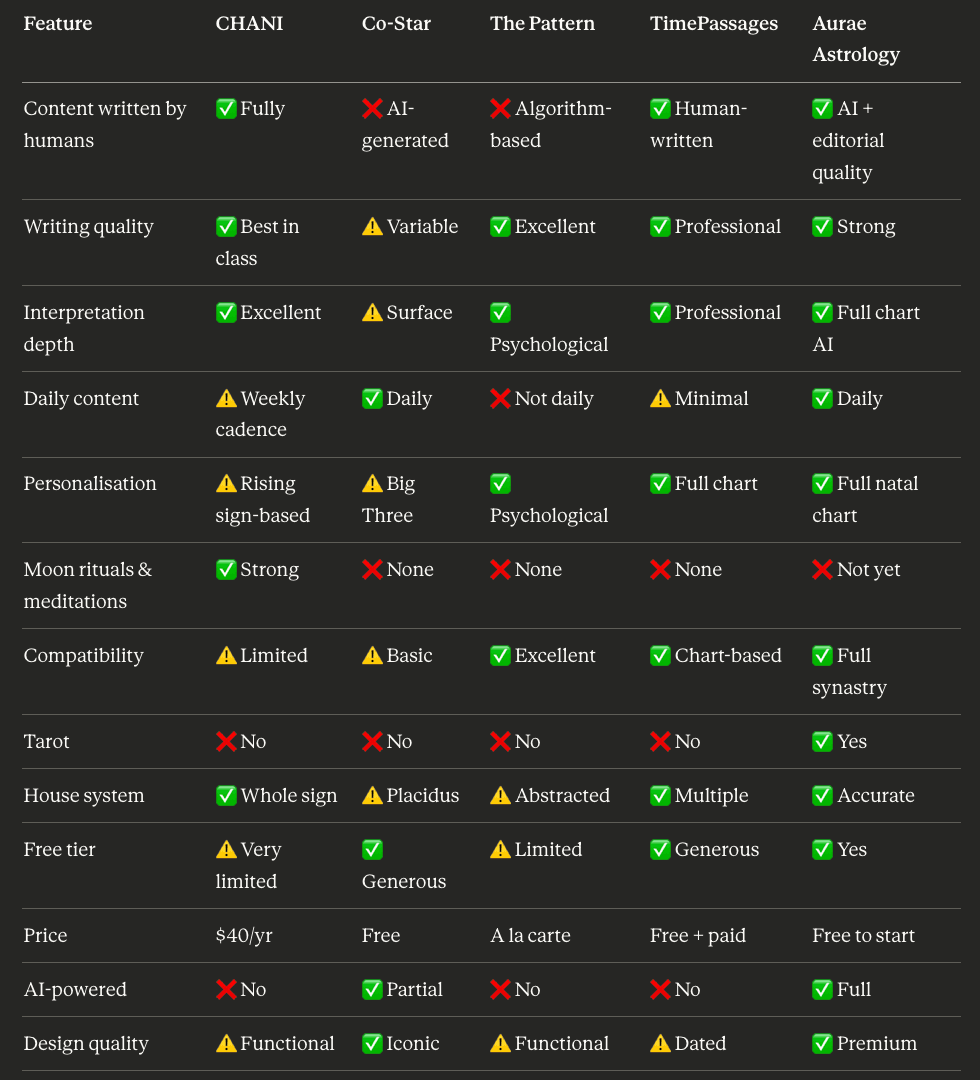
CHANI vs. Competitors
Who Is CHANI Best For?
The CHANI app is best suited to users who prioritise writing quality and human astrological expertise above all else — particularly those who want astrology integrated into a broader mindfulness, wellness, or spiritual practice, and who are willing to pay for genuinely authored content.
It's an excellent fit for intermediate astrology enthusiasts who have moved beyond Sun-sign horoscopes, understand the significance of their Rising sign, and want weekly content that rewards careful reading. The moon ritual and meditation features make it particularly strong for users who want a practice rather than just information.
It's less well-suited to beginners who need a gentler entry point, budget-conscious users for whom $40/year is a significant spend, users who want daily personalised content, or those whose primary interest is compatibility analysis or learning astrological mechanics.
Our Verdict
Rating: 4 / 5
The CHANI app is one of the most carefully constructed and editorially distinguished astrology apps available. Chani Nicholas's writing is a genuine differentiator — the kind of quality that changes how you experience astrological content and raises your expectations for everything else you read. The whole-sign house system, the wellness integration, the moon rituals, and the principled commitment to human authorship all reflect a serious, sustained engagement with astrological practice.
The limitations are real: the cost, the content cadence, the personalisation ceiling, and the modest visual design are genuine constraints. But they are the honest trade-offs of a deliberate philosophy rather than oversights — and for the user CHANI is built for, they are entirely acceptable.
If you value quality above all else and want an astrological practice that feels considered and intentional, CHANI is among the best options available.
Love CHANI's Craft? Here's What Complements It
CHANI's strength is editorial quality and weekly depth. The gaps it leaves are daily personalisation, full natal chart analysis beyond the Rising sign, tarot, and compatibility synastry — features that many astrology enthusiasts want alongside their weekly anchoring content.
Aurae Astrology is built to fill exactly those gaps — AI-powered daily horoscopes rooted in your complete [natal chart [link: what-is-a-natal-chart]], covering all ten planets and twelve houses, with tarot, full synastry compatibility, and real-time sky tracking included. Many serious astrology practitioners use both CHANI and Aurae together: CHANI for weekly editorial depth and ritual practice, Aurae for daily personalised chart-based guidance. They complement each other well.
Try Aurae free at auraeastrology.com →
Frequently Asked Questions
What is the CHANI app? The CHANI app is a Western astrology and wellness application created by astrologer and author Chani Nicholas. It offers weekly horoscopes, birth chart readings, new and full moon rituals, audio meditations, and transit content — all written by human astrologers with no AI-generated content. It uses the whole-sign house system and is available on iOS and Android.
Is the CHANI app worth it? For users who prioritise human-written astrological content and want astrology integrated into a wellness or spiritual practice, CHANI is widely considered worth its subscription cost. The writing quality is genuinely exceptional and difficult to find elsewhere. For casual users who primarily want a free daily horoscope, there are more cost-effective alternatives.
How much does the CHANI app cost? The CHANI app costs approximately $14.99/month or $40/year. A very limited amount of content is available free, but full access requires a paid subscription. There are no additional in-app purchases beyond the subscription.
What house system does the CHANI app use? The CHANI app uses the whole-sign house system — a traditional astrological method in which each house corresponds exactly to one zodiac sign, beginning from the Rising sign. Many traditional astrologers consider whole-sign houses more historically grounded and consistently accurate than the Placidus system used by most mainstream apps.
Is the CHANI app available on Android? Yes, the CHANI app is available on both iOS and Android devices.
What is the difference between CHANI and Co-Star? [CHANI [link: chani-review]] offers human-written, editorially deep weekly content within a wellness framework, using whole-sign houses and requiring a subscription. [Co-Star [link: co-star-review]] offers AI-generated daily content with stronger social features, a traditional Placidus chart, and a generous free tier. CHANI prioritises quality and intentional practice; Co-Star prioritises accessibility and daily habit formation.
Does CHANI use AI? No — the CHANI app does not use AI to generate any of its content. Every piece of written and audio content is produced by Chani Nicholas and her team of human astrologers. This is a deliberate, publicly stated design philosophy that distinguishes CHANI from most competitors.
Who is Chani Nicholas? Chani Nicholas is a professional astrologer, author, and activist based in Los Angeles. She is the author of You Were Born for This, a New York Times bestselling book on natal chart reading, and has practiced astrology professionally for over two decades. She is known for bringing a progressive, inclusive perspective to astrological practice.