AI Tarot Reading: How It Works, How Accurate It Is, and What to Look For
AI tarot reading uses artificial intelligence — specifically large language models trained on tarot symbolism, Jungian archetypal psychology, and centuries of interpretive tradition — to draw digital cards and generate personalised interpretations based on your question and spread. It's genuinely useful as a self-reflection tool, available 24/7 at no cost, and increasingly sophisticated. It does not replace the intuition and emotional resonance of a skilled human reader — but it doesn't need to, because that's not what most people are actually looking for when they reach for a tarot app.
By the Aurae Astrology Team · 11 min read · Updated March 2026
Quick answer: AI tarot reading uses artificial intelligence — specifically large language models trained on tarot symbolism, Jungian archetypal psychology, and centuries of interpretive tradition — to draw digital cards and generate personalised interpretations based on your question and spread. It's genuinely useful as a self-reflection tool, available 24/7 at no cost, and increasingly sophisticated. It does not replace the intuition and emotional resonance of a skilled human reader — but it doesn't need to, because that's not what most people are actually looking for when they reach for a tarot app.
What Is AI Tarot Reading?
AI tarot reading is a digital tarot practice in which artificial intelligence draws cards from a virtual deck and generates personalised interpretations based on your question, the cards drawn, and their positions within a spread — using language models trained on centuries of tarot symbolism and psychological frameworks.
Tarot has been used as a tool for reflection, guidance, and self-understanding for centuries. The standard deck used by most practitioners today — the Rider-Waite-Smith, first published in 1909 — contains 78 cards: 22 Major Arcana representing archetypal life themes, and 56 Minor Arcana addressing the texture of everyday experience across four elemental suits.
A human tarot reader draws cards in response to a question, interprets each card's symbolism in the context of its position within the spread, and weaves the individual card meanings into a coherent narrative that addresses the querent's situation. AI tarot reading replicates this process digitally — using a randomisation mechanism to simulate the card draw, and a language model to perform the interpretation.
What makes AI tarot meaningfully different from simply looking up card meanings in a book is the synthesis: a well-designed AI tarot system doesn't just describe what the Three of Swords means in isolation. It interprets what the Three of Swords means in the "challenges" position of a Celtic Cross spread, following The Tower in the "crossing influences" position, given your specific question about a workplace conflict. That contextual, positional interpretation is what moves AI tarot from a card dictionary to something that approaches an actual reading.
As RankmyAI, which tracks the AI tool landscape, reported in early 2026, there are now over 33 dedicated AI tarot tools competing for users' attention — a significant market that reflects genuine and growing demand for accessible, on-demand tarot practice.
How Does AI Tarot Reading Work?
AI tarot reading works through two distinct components: a randomisation mechanism that simulates the card draw, and a language model that interprets the drawn cards in the context of your question and spread position.
Understanding both components separately helps you evaluate the quality of any AI tarot tool you encounter.
The Card Draw
In traditional tarot, the physical act of shuffling and drawing cards is considered meaningful — a process of bringing subconscious intention into contact with chance in a way that practitioners describe as synchronistic. In AI tarot, this is replicated by a digital randomisation algorithm that selects cards from the full 78-card deck. Reputable AI tarot tools use true randomisation rather than selecting cards based on the content of your question — though it's worth noting that some lower-quality tools do the latter, selecting "relevant" cards based on keywords in your prompt rather than genuine randomisation.
The Interpretation Layer
This is where AI tarot tools vary most dramatically in quality. As aimag.me's independent analysis of tarot apps usefully categorises, there are three meaningfully different types of tarot tools:
Learning apps (such as Labyrinthos and Biddy Tarot) — these are essentially interactive encyclopedias. They teach card meanings but don't generate readings.
Static database reading apps — these draw cards and display pre-written interpretations from a fixed library. The Moon always means the same thing regardless of your question, spread position, or what other cards appeared alongside it.
AI-powered interpretation apps — these use language models to generate contextual interpretations that respond to your specific question, the specific cards drawn, and the relationships between those cards in their respective positions. This is the newest category and produces a fundamentally different experience from the other two.
The distinction between a static database app and a genuine AI interpretation app is the most important thing to understand when evaluating any tool that calls itself "AI tarot." As aimag.me puts it bluntly: "A tarot app that shows you beautiful card animations and then displays a paragraph that could apply to literally anyone has given you entertainment, not reflection."
A genuine AI tarot interpretation considers at minimum:
- The specific card drawn in each position
- The position's meaning within the spread (past, present, future; hopes, fears, outcome; etc.)
- Whether the card is upright or reversed
- How the card's symbolism interacts with the other cards in the spread
- The theme or question you've brought to the reading
The best AI tarot systems also maintain memory across sessions — recognising when certain cards or themes appear repeatedly across multiple readings, which is how pattern recognition in tarot practice actually works for experienced practitioners.
Is AI Tarot Reading Accurate?
AI tarot reading is accurate in a meaningful but specific sense: it accurately applies established tarot symbolism and interpretive tradition to your cards and question. It is not accurate in the sense of predicting specific future events — but neither is traditional tarot, according to most serious practitioners.
This is the question most people bring to AI tarot, and it deserves an honest answer that doesn't overclaim in either direction.
What "Accuracy" Actually Means in Tarot
Tarot is not a predictive system in the empirical sense. No reputable tarot practitioner — human or AI — claims that the cards cause events or that drawing The Tower means something will literally collapse. What tarot does is provide a symbolic framework for reflection: a way of externalising and examining inner states, patterns, and possibilities through archetypal imagery.
As one of the most balanced assessments of AI tarot accuracy on the Alibaba Product Insights blog explains, what AI tarot can do is "identify high-probability psychological patterns based on language cues" — pattern recognition, not prophecy. When evaluated against this realistic standard, the best AI tarot tools perform genuinely well.
What the Research Shows
A 2022 study cited by multiple tarot analysis sources tracked 127 participants receiving identical tarot spread interpretations — one delivered via AI chatbot, one by a certified human reader. Both groups rated content accuracy similarly (78% vs 79%). However, the human-read group reported significantly higher emotional resonance and greater likelihood of acting on the insights received. This finding reflects the genuine strength of AI tarot (interpretive accuracy is comparable) alongside its genuine limitation (emotional depth and personal resonance remain harder to replicate).
The Confirmation Bias Question
One honest limitation of AI tarot that's worth naming directly: research into user responses to AI-generated tarot readings suggests that high user satisfaction is partly driven by confirmation bias — the tendency to notice and remember the parts of a reading that fit what we already believe or feel. This isn't unique to AI tarot; it applies to human readings too. But AI systems that optimise for engagement — reinforcing what users want to hear rather than genuinely challenging them — can accelerate this effect.
The most useful frame, as Selfgazer's thoughtful analysis of AI tarot's value puts it, is to understand AI as "a complementary tool" rather than an oracle: "Much like flipping through a tarot encyclopedia, a carefully designed AI can speed up the search for information. However, the crucial act of weaving meaning into personal context belongs to the individual."
The Forer Effect
AI tarot interpretations can also be susceptible to what psychologists call the Forer effect — the tendency for people to accept vague, general statements as highly personally relevant. The best AI tarot tools write specifically and concretely rather than relying on statements that could apply to anyone. A reading that says "you may be going through a period of change and feeling uncertain about the future" is not a tarot reading — it's a universally applicable statement dressed in symbolic language. When evaluating an AI tarot reading, ask: "What specific, non-generic insight did this provide that I didn't already put into the question?"
AI Tarot vs Human Reader: An Honest Comparison
AI tarot and human tarot readers serve different but overlapping needs. Neither is universally better — the right choice depends on what you're looking for, when you need it, and what you're willing to pay.
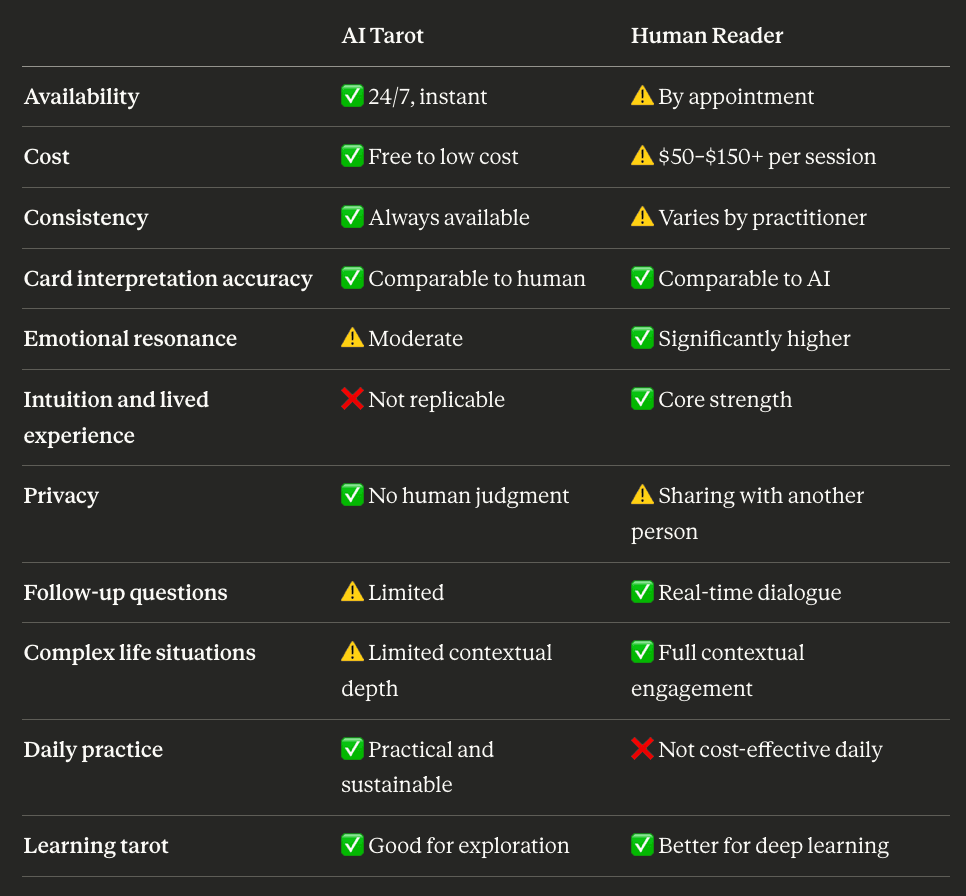
As a practicing reader's honest assessment at awakenche.org notes, what a skilled human reader brings that AI cannot replicate is access to "the 6th sense" — empathic attunement, cultural sensitivity, the ability to hear what isn't said, and the lived wisdom of thousands of readings with real people in real situations. These qualities matter most for complex, emotionally significant questions where the full context of a person's life informs the reading.
AI tarot, on the other hand, excels precisely where human readers are least accessible: at 2am when you need to process something before you can sleep, for daily reflective pulls that don't require a $100 consultation, for private exploration of sensitive questions you're not ready to share with another person, and as a consistent, judgment-free framework for ongoing self-reflection.
The most sophisticated practitioners, as YourTango's account of using ChatGPT for a tarot reading explores, are finding ways to use AI as a complement to human practice — using AI for daily pulls and pattern tracking, and reserving human consultation for the readings that genuinely need another person's presence.
Explore Aurae's combined tarot and astrology platform free at auraeastrology.com →
Common AI Tarot Spreads Explained
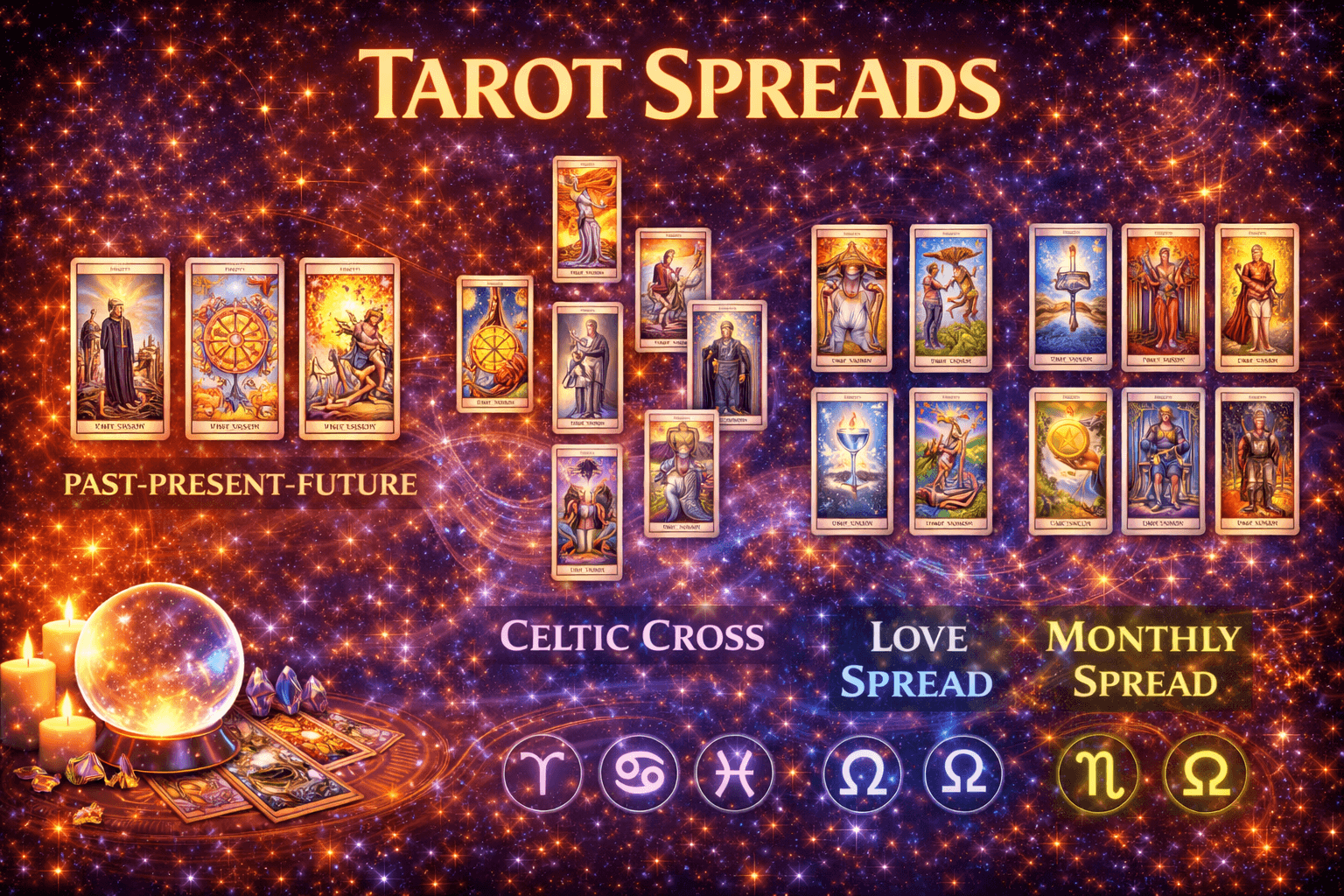
A spread is the arrangement of cards in a tarot reading — each position in the spread carries a specific meaning that contextualises the card drawn there. Understanding the most common spreads helps you ask better questions and get more from any AI tarot tool.
One-Card Pull
The simplest and most sustainable daily practice. Draw a single card and ask: "What energy or theme is most relevant for me today?" or "What do I need to focus on right now?" A one-card pull with genuine AI interpretation is more useful than a three-card pull with a static database response — quality of interpretation matters more than quantity of cards.
Three-Card Spread
The most commonly used spread for specific questions. The three positions typically represent: Past (what has led to this situation), Present (the current energy or challenge), Future (the likely direction if current patterns continue). Variations include: Mind / Body / Spirit, Situation / Action / Outcome, and What to embrace / What to release / What to move toward.
Celtic Cross
The most comprehensive standard spread, using ten cards to explore a situation from multiple angles: the central situation, what crosses it (the challenge), the foundation, the recent past, the possible future, what's on the horizon, your inner state, your environment, your hopes and fears, and the likely outcome. A genuine AI tarot system that can interpret a Celtic Cross coherently — weaving all ten cards into a unified reading — represents a significantly higher level of sophistication than a simple three-card tool.
Relationship Spread
Typically a five to seven card spread that addresses the dynamics between two people: each person's energy, what connects them, what challenges them, and the relationship's potential direction. Particularly useful for exploring relational patterns without the potential awkwardness of discussing them with a human reader.
Daily Reflection Pull
Many AI tarot tools now offer a daily card feature — a single card pulled each morning with an interpretation tailored to current astrological weather or simply to the day's energy. This is perhaps the most practically valuable AI tarot feature for regular practitioners: a consistent daily touchpoint that costs nothing and takes less than two minutes.
How to Get the Most From an AI Tarot Reading
AI tarot is a reflection tool, not an answer machine. How you engage with it determines most of its value. Here are the practices that consistently produce better readings:
Ask specific questions
The single most important thing you can do to improve an AI tarot reading is ask a specific question rather than a general one. "What is blocking me in my career right now?" produces a significantly more useful reading than "Tell me about my career." The AI interprets cards in relation to your question — a more specific question gives the AI more to work with and produces interpretations that feel more targeted and relevant.
Focus on what you can influence
Questions framed around your own choices, awareness, and inner states tend to produce more useful readings than questions framed as pure prediction. "What do I need to understand about this relationship?" is more actionable than "Will this relationship work out?" The former invites reflection and agency; the latter invites passive prophecy that is rarely meaningful.
Sit with the reading before reacting
The temptation with any instant-access tool is to consume it quickly and move on. But the value of tarot — AI or human — often emerges in the second and third reading of the interpretation, not the first. Take a moment after reading to ask: "What part of this resonated, and why? What part didn't land, and is that discomfort telling me something?"
Use it as a journaling prompt
Research into how users get the most from AI tarot consistently finds that the highest-satisfaction users are those who treat readings as prompts for written reflection rather than answers to consume and close. Writing even two or three sentences about what a reading surfaced for you extends its value significantly.
Track patterns over time
If you use AI tarot regularly, pay attention to which cards appear repeatedly — and which positions they tend to occupy. A reading system with memory across sessions can surface these patterns automatically. Without that feature, maintaining a simple personal log of your draws is one of the most valuable practices you can develop.
Know when to seek human support
AI tarot is genuinely useful for everyday reflection, decision clarity, and ongoing personal exploration. It is not appropriate as the primary support during significant mental health challenges, grief, trauma, or crisis. If a reading touches something that feels too significant or distressing to process alone, reach for a trusted person — practitioner, therapist, or friend — rather than another AI reading.
The Best AI Tarot Reading Tools in 2026
The AI tarot market is growing rapidly, but quality varies enormously. Here's an honest overview of the main options:
Aurae Astrology — Best for AI Tarot Integrated With Your Birth Chart
auraeastrology.com · Free to start
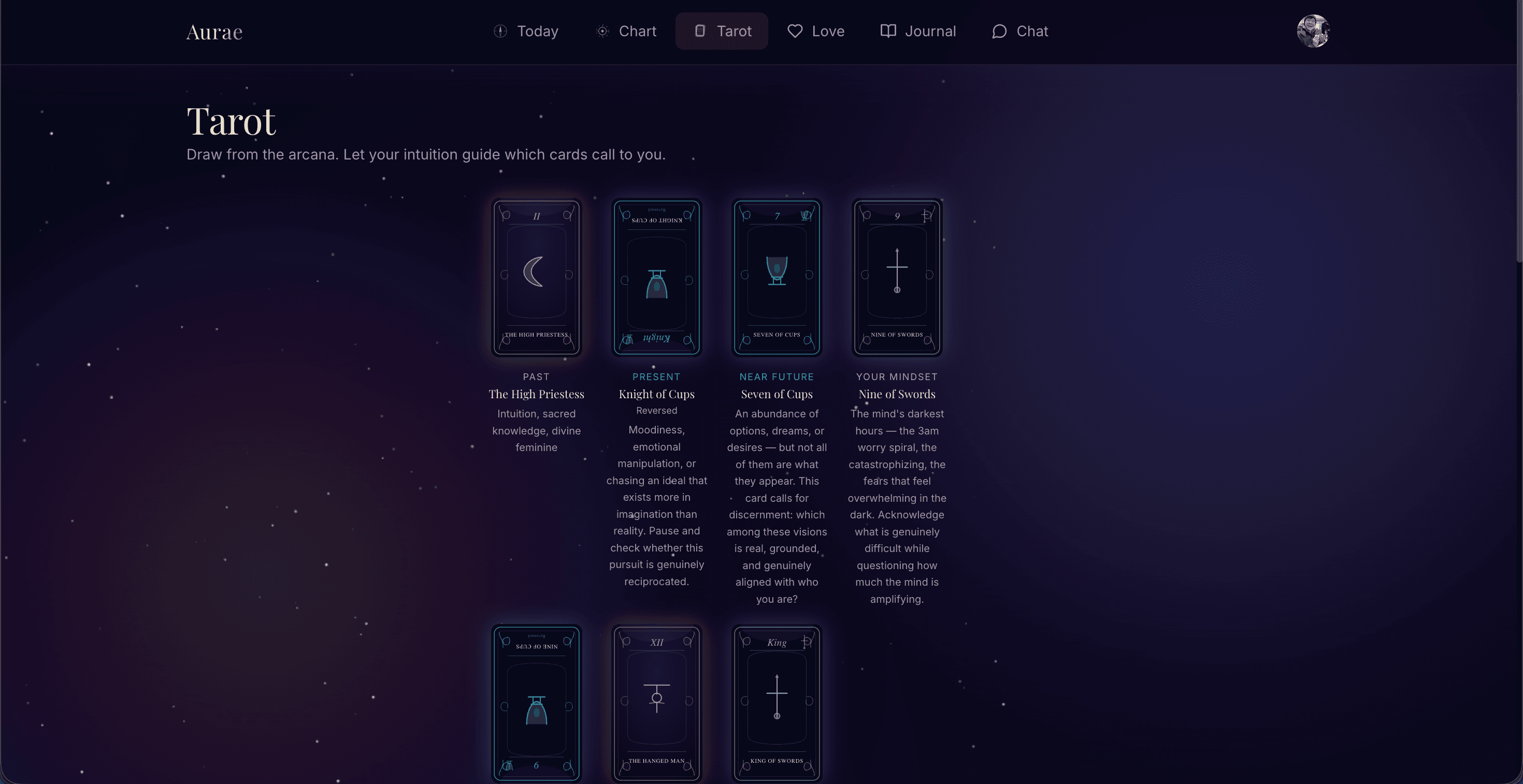
Aurae is unique in the AI tarot space for one specific reason: it's the only platform that integrates AI tarot readings with your full natal birth chart and real-time astrological context. Your daily tarot pull isn't drawn in a vacuum — it's interpreted in relation to your specific planetary placements, current transits, and the actual astrological weather of the day.
This integration matters because tarot and astrology are deeply structurally connected systems (each Major Arcana card corresponds to a zodiac sign or planet, each suit maps to an element), and reading them in concert produces significantly richer interpretation than either system alone. For users who want their tarot practice grounded in astrological context — not just symbolic content — Aurae offers something no other tool in this list provides.
Best for: Users who already engage with astrology and want tarot integrated with their birth chart, daily horoscopes, and planetary transits in one platform.
Try Aurae's integrated tarot free at auraeastrology.com →
TarotReader.ai — Best for Simple, Specific Questions
A focused AI tarot platform offering three-card readings via natural language input. Clean interface, no frills, and reasonably good at contextual interpretation for straightforward questions. Better than a static database tool; falls short of deeper spread analysis or cross-session pattern tracking.
Best for: Quick, specific questions where a three-card reading is sufficient.
Labyrinthos — Best for Learning Tarot Through AI
More of a learning platform than a reading platform, Labyrinthos combines AI-assisted card meaning exploration with gamified learning tools, flashcards, and an extensive card encyclopedia. If your goal is to develop your own tarot reading skill rather than receive readings, Labyrinthos is among the best-designed tools available.
Best for: Beginners who want to learn tarot as a practice, not just receive readings.
Quin — Best for Daily Practice With Personalisation
Quin offers customisable spread styles, a reading calendar for tracking draws over time, and the ability to upload photos of your own physical deck for AI interpretation. The calendar and tracking features make it one of the better tools for developing a consistent daily tarot practice.
Best for: Regular practitioners who want to track readings over time and work with their own physical deck.
Tarotify — Best for Spread Variety
Tarotify offers a wider range of spread options than most competitors, alongside a card encyclopedia, journaling tools, and multilingual support. The AI interpretation quality is adequate for standard spreads though not as strong for complex readings.
Best for: Users who want spread variety and a built-in journaling feature alongside their readings.
AI Tarot and Astrology: A Powerful Combination
One of the most underexplored dimensions of AI tarot is how much richer it becomes when combined with astrological context. The connection between these two systems isn't superficial — it's structural.
As we explored in our guide to tarot cards and zodiac signs, each of the 22 Major Arcana cards corresponds to a zodiac sign or planet in the Western esoteric tradition codified by the Hermetic Order of the Golden Dawn. The four tarot suits map directly onto the four astrological elements. Individual Minor Arcana cards correspond to specific degrees and decans of the zodiac.
This means that knowing your natal birth chart deepens your tarot practice in concrete ways. If you have a prominent Scorpio placement in your chart and repeatedly draw the Death card, that's a different and richer observation than drawing it without that context. If you draw the Star (Aquarius) during a period when Saturn is transiting your 11th house, the resonance between those two layers of meaning — Aquarian themes of vision and community, Saturn asking for structure and commitment — can be meaningfully illuminating.
Most AI tarot tools treat readings in isolation from any astrological context. Aurae's approach — grounding each day's tarot draw in your specific birth chart and current planetary transits — represents a genuinely more sophisticated integration of these two complementary systems, and produces the kind of layered, personalised interpretation that serious practitioners have always found most meaningful.
Explore Aurae's combined tarot and astrology platform free at auraeastrology.com →
Frequently Asked Questions
What is AI tarot reading? AI tarot reading is a digital practice in which artificial intelligence draws cards from a virtual 78-card tarot deck and generates personalised interpretations based on your question, the cards drawn, and their positions within a chosen spread. It uses large language models trained on tarot symbolism, archetypal psychology, and centuries of interpretive tradition to simulate the experience of a tarot reading without requiring a human practitioner.
How accurate is AI tarot reading? AI tarot reading is accurate in a meaningful sense — it accurately applies established tarot symbolism and interpretive tradition to your specific cards, question, and spread positions. Research comparing AI and human tarot interpretations found both scored similarly on content accuracy (around 78-79%). AI tarot is not a predictive system in the empirical sense — it's a reflection tool, and its value lies in the quality of the symbolic framework it applies rather than in any ability to predict future events.
Is AI tarot reading free? Many AI tarot reading tools offer free tiers, though the quality and depth available without payment varies significantly. Some platforms that market themselves as free gate their most useful features behind in-app purchases. The best free options — including Aurae Astrology's integrated tarot feature — offer genuine meaningful functionality without requiring immediate payment.
Can AI do a tarot reading? Yes — a well-designed AI tarot tool can draw cards, interpret their symbolism in the context of a specific question and spread position, consider reversed card meanings, weave individual card meanings into a coherent narrative, and track patterns across multiple readings. The quality depends significantly on whether the tool uses genuine AI interpretation or simply displays pre-written static card definitions.
Is AI tarot better than a human reader? Neither is universally better — they serve different needs. AI tarot excels at accessibility (24/7 availability, no cost, complete privacy), consistency, and daily practice sustainability. Human readers excel at emotional resonance, intuitive engagement, real-time contextual dialogue, and the complex wisdom that comes from lived astrological and tarot practice. The most sophisticated users of both tend to use AI for regular daily reflection and human consultation for significant life questions that deserve another person's full attention.
How does AI tarot reading work? AI tarot reading works through two components: a randomisation mechanism that simulates the card draw from a full 78-card virtual deck, and a language model that interprets the drawn cards based on your question, spread type, card positions, and card-to-card relationships. The best AI tarot tools generate fresh, contextualised interpretations for each reading rather than displaying pre-written descriptions from a fixed database.
What is the best free AI tarot reading? The best free AI tarot reading tools in 2026 include Aurae Astrology (which uniquely integrates tarot with your birth chart and real-time astrological context), TarotReader.ai (for straightforward three-card pulls), and Quin (for daily practice with a reading calendar). Quality varies significantly — look for tools that generate contextual interpretations based on your specific question and card positions, rather than displaying generic pre-written card meanings.
Can I use AI tarot with my own deck? Some AI tarot tools — including Quin and Tarotify — allow you to photograph your own physical deck and receive AI interpretations of the cards you've drawn. This is a useful hybrid approach for practitioners who have an existing physical practice and want AI interpretation without giving up the tactile ritual of working with a physical deck.