AI Astrology Birth Chart: The Complete Guide for 2026
An AI astrology birth chart is a natal chart — a map of where the planets were at the exact moment of your birth — interpreted by artificial intelligence rather than a human astrologer. The best AI birth chart tools analyse all ten planets, twelve houses, and every major aspect to produce personalised readings that rival the depth of a professional consultation, available instantly and at a fraction of the cost.
By the Aurae Astrology Team · 12 min read · Updated March 2026
Quick answer: An AI astrology birth chart is a natal chart — a map of where the planets were at the exact moment of your birth — interpreted by artificial intelligence rather than a human astrologer. The best AI birth chart tools analyse all ten planets, twelve houses, and every major aspect to produce personalised readings that rival the depth of a professional consultation, available instantly and at a fraction of the cost.
What Is an AI Astrology Birth Chart?
An AI astrology birth chart is your natal chart — calculated from your exact birth date, time, and location — interpreted by an artificial intelligence system trained on traditional astrological principles, rather than by a human practitioner.
To understand what makes the AI component significant, it helps to understand what a birth chart actually is. Your natal chart is a snapshot of the solar system at the precise moment you were born. It records the positions of the Sun, Moon, and eight planets across twelve zodiac signs and twelve astrological houses, and maps the geometric relationships — called aspects — between each of those bodies.
A traditional astrologer reads this chart by synthesising those dozens of data points into a coherent portrait of your personality, life themes, strengths, challenges, and timing cycles. It's a skill that takes years to develop, which is why a good astrology consultation historically cost $100–$300 or more and required booking days or weeks in advance.
AI changes that access equation entirely. A well-designed AI birth chart system can perform that same synthesis — analysing planetary placements, house positions, aspects, and transits — in seconds, at any time, available to anyone with a smartphone.
The quality of that synthesis varies enormously depending on the system. That's what this guide is designed to help you navigate.
How Does AI Read a Birth Chart?
AI reads a birth chart by first calculating accurate planetary positions using astronomical data, then applying a trained interpretation system to analyse what those positions mean individually and in combination — producing personalised written readings that reflect your specific chart rather than generic sign-based content.
The process involves two distinct components that are easy to conflate but critically different in quality:
Step 1: Chart Calculation
The AI calculates where every planet was at your birth using an astronomical ephemeris — a database of planetary positions across time. The most reliable AI astrology systems use the Swiss Ephemeris or NASA JPL data as their source, both of which are accurate to within fractions of a degree. This calculation component is largely standardised across reputable tools — chart calculation accuracy is relatively easy to achieve and verify.
What varies dramatically is what happens next.
Step 2: Chart Interpretation
This is where AI quality diverges sharply. There are three meaningfully different levels of interpretation sophistication in the current market:
Level 1 — Template-based systems. Basic AI astrology tools work by assembling pre-written text blocks: a paragraph describing Moon in Scorpio, another describing Sun in Taurus, another describing Venus in the 7th house. These are combined into a report that looks comprehensive but is actually a dressed-up template — the same Moon in Scorpio description appears in every reading regardless of what else is in the chart. This is the majority of the market.
Level 2 — Language model interpretation. More advanced systems use large language models trained on astrological texts to generate interpretations that read more naturally and incorporate some contextual awareness. These systems produce more fluent, engaging content, but without access to real astronomical calculation tools, they risk generating plausible-sounding but astrologically incoherent text — particularly for complex aspect patterns and house configurations.
Level 3 — Integrated full-chart AI. The most sophisticated AI birth chart systems combine accurate astronomical calculation with interpretation models that synthesise across your full chart — considering not just individual placements but how they interact. A Saturn in the 10th house means something different when it's also conjunct your chart ruler and trine your Moon than it does in isolation. Level 3 systems attempt to capture those interactions. This is rare and is what separates genuinely useful AI birth chart tools from the majority of the market.
What a Good AI Birth Chart Covers
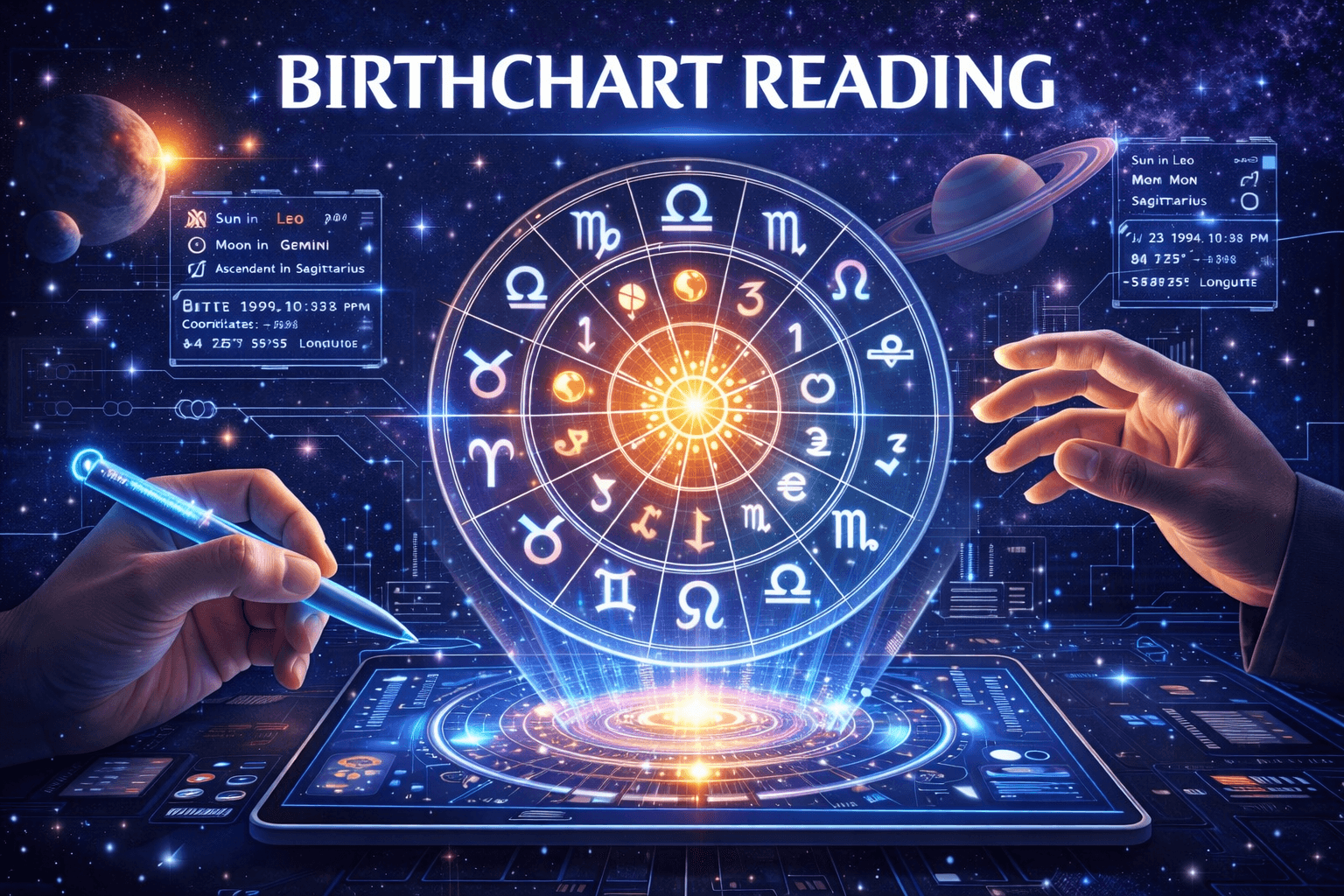
A genuinely comprehensive AI birth chart interpretation should cover the following elements. Use this as a checklist when evaluating any tool:
The Ten Planets
Sun, Moon, Mercury, Venus, Mars, Jupiter, Saturn, Uranus, Neptune, and Pluto — each placed in a zodiac sign and an astrological house. Many basic tools cover only the Big Three (Sun, Moon, Rising) and present this as a full reading. It isn't. The remaining seven planets carry significant astrological meaning that shapes your chart's complete picture in ways the Big Three alone cannot capture.
The Twelve Houses
Your natal chart is divided into twelve houses, each governing a different life domain — identity, values, communication, home, creativity, health, relationships, transformation, philosophy, career, community, and the unconscious. Where your planets fall in these houses is as significant as what sign they occupy. A Sun in Capricorn in the 5th house has a fundamentally different expression than a Sun in Capricorn in the 10th house, even though both people share the same Sun sign.
Major Aspects
Aspects are the geometric angles between planets — conjunctions, oppositions, trines, squares, sextiles, and more. They describe the dynamic relationships between planetary energies in your chart: which impulses work in natural harmony, which create productive tension, and which represent significant life themes to navigate. A chart without aspect interpretation is missing one of its most important and personally revealing dimensions.
The Rising Sign and Chart Ruler
Your Rising sign is the zodiac sign that was rising on the eastern horizon at your birth. It determines your house structure — which planets fall in which houses — and establishes your chart ruler: the planet that governs your Rising sign and carries special significance throughout your chart. A complete AI birth chart reading should identify and interpret your chart ruler's placement and its relationship to the rest of your chart.
Current Transits
A good AI birth chart tool doesn't just interpret your natal chart as a static document — it contextualises your chart within current planetary movements. Transits show where today's planets are sitting relative to your birth placements, which is what drives the timing of experiences and the themes active in your life right now. This is what transforms a birth chart from a one-time personality portrait into a living, ongoing tool for daily guidance.
How Accurate Is AI Birth Chart Reading?
AI birth chart reading is highly accurate for chart calculations — astronomical data is precise and verifiable. The accuracy of AI interpretation depends significantly on which system you use: the best AI tools produce readings that experienced astrologers find genuinely insightful; lower-quality tools produce generic content that applies to broad demographics rather than individuals.
This is the question most people searching "AI astrology birth chart" most want answered, so it deserves a direct and nuanced response.
What AI Gets Right
The planetary positions in a reputable AI birth chart are astronomically accurate. Your Sun, Moon, Rising, and all planetary placements will be correctly calculated if the tool uses a reliable ephemeris. This is the foundation, and the good news is that most reputable tools get it right.
Beyond calculation, well-designed AI interpretation systems can synthesise astrological meaning accurately across hundreds of possible planetary configurations. The patterns in astrology — what Saturn in the 12th house tends to mean, how a Moon-Pluto square manifests emotionally, what a strong 8th house suggests about your relationship with transformation — are documented across centuries of astrological tradition that AI systems can be trained on effectively.
For users who've had professional consultations, a well-designed AI birth chart reading at its best produces insights that feel meaningfully comparable — specific, resonant, and grounded in genuine astrological reasoning.
Where AI Falls Short
AI interpretation struggles most with the highly individualised synthesis that distinguishes the best human astrologers. A skilled practitioner reads your chart as a living whole — noticing the specific configuration that makes your chart unique, the unusual pattern that changes the meaning of what might otherwise be a standard placement, and the nuanced interplay between a challenging aspect and the resources elsewhere in the chart that help you navigate it.
AI systems that interpret placements in relative isolation — Sun here means this, Moon there means that — miss this holistic dimension. The gap between a good AI reading and a great human reading is smallest for straightforward charts with clear dominant themes, and largest for complex charts with many interacting factors.
The honest answer: AI birth chart reading in 2026 is genuinely useful and often meaningfully accurate — particularly from the best tools in the market. It's not a replacement for a gifted human astrologer, but it's a significant improvement over generic horoscope content and accessible to anyone without booking or cost barriers.
Free vs Paid AI Birth Chart Tools
Free AI birth chart tools typically offer accurate planetary calculations with template-based interpretations. Paid tools generally provide deeper, more individually synthesised readings, daily personalised content, and more sophisticated AI interpretation. The best apps offer meaningful free tiers that let you assess quality before committing.
Here's how to think about the free vs paid question:
Free tools are worth using for: Getting your accurate chart calculations, identifying your planetary placements and house positions, and exploring basic interpretations of individual placements. Several strong tools — including Aurae Astrology and Co-Star — offer meaningful free chart functionality.
Paid tools add value through: Full natal chart synthesis that considers how all your placements interact, daily AI-powered horoscopes rooted in your specific chart, transit tracking, compatibility synastry, and the ongoing interpretive relationship that makes astrology most useful over time.
A common mistake is assuming that a free birth chart report is complete because it's long. Many free tools generate comprehensive-looking reports by assembling dozens of generic placement descriptions — but that's not the same as a synthesised reading of your chart as a whole. Length doesn't equal depth.
How to Get Your AI Birth Chart Reading
Getting an accurate AI birth chart reading requires three pieces of information and takes less than two minutes with any reputable tool.
What You Need
1. Your birth date — day, month, and year.
2. Your birth time — as precise as possible. This is the most commonly overlooked requirement and the most consequential. Your birth time determines your Rising sign and your house positions — two of the most personally significant dimensions of your chart. Even a difference of a few minutes can shift your Rising sign or move a planet from one house to another. If you don't know your exact birth time, check your birth certificate, ask a parent, or request your birth records from the hospital or registry office where you were born.
3. Your birth location — the city or town where you were born, not where you grew up or currently live. Planetary positions at birth are calculated relative to your birth location's latitude and longitude.
Step-by-Step: Getting Your AI Birth Chart on Aurae
- Visit auraeastrology.com and tap "Cast your chart — it's free"
- Enter your birth date, birth time, and birth city
- Aurae calculates your complete natal chart using precise astronomical data
- Your AI-powered interpretation begins — covering all ten planets, twelve houses, and major aspects
- Access your daily AI-powered horoscope, tarot readings, and compatibility analysis from your chart dashboard
The full process takes under two minutes and requires no existing astrological knowledge.
The Best AI Birth Chart Apps in 2026
Not all AI birth chart tools are created equal. Here are the strongest options currently available, evaluated by a practicing astrologer:
1. Aurae Astrology — Best Overall AI Birth Chart
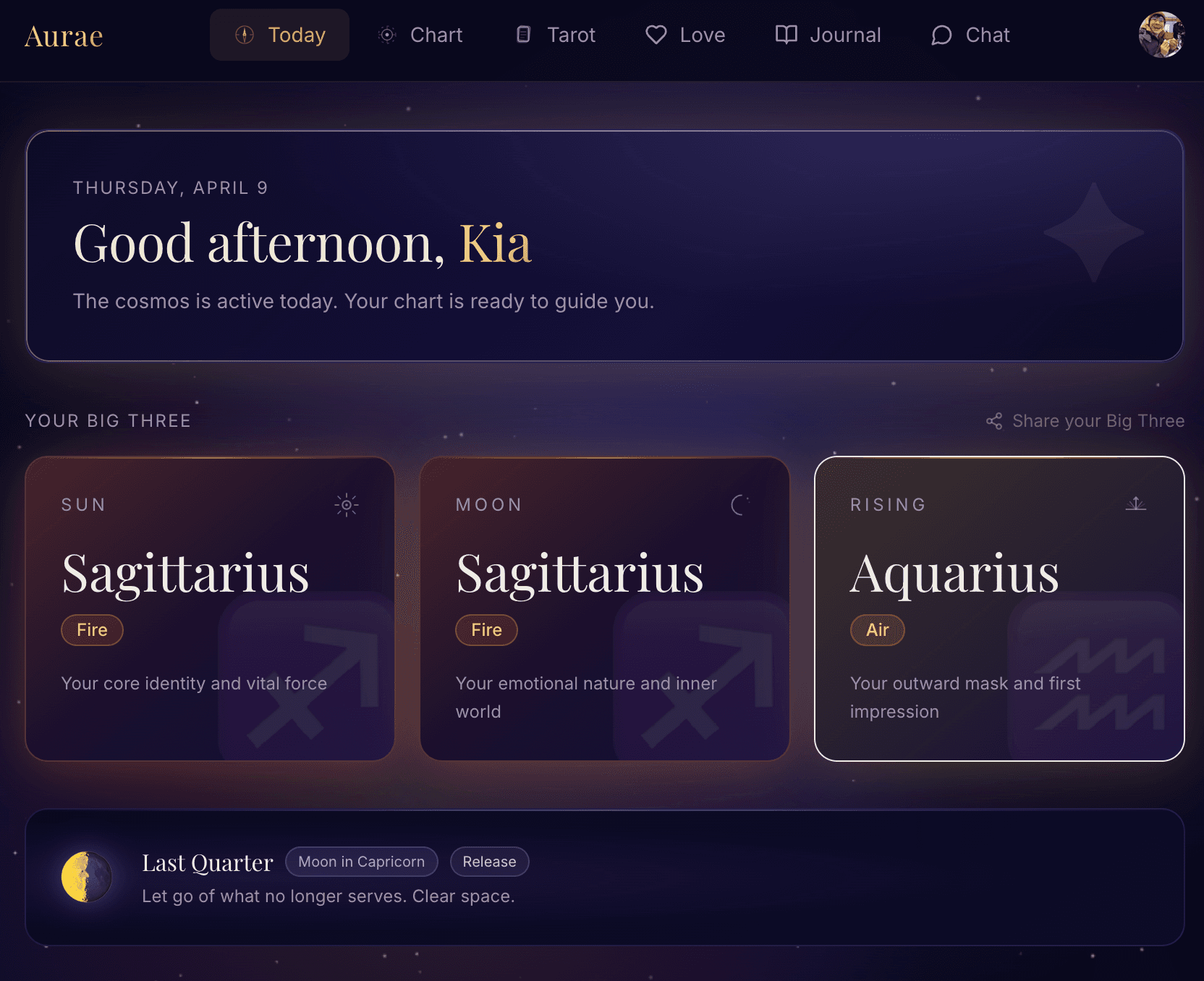
auraeastrology.com · Free to start · iOS & Android
Aurae leads the category for the depth and genuine personalisation of its AI birth chart interpretation. Where most tools stop at the Big Three, Aurae's AI engages with your complete chart — all ten planets, twelve houses, and every major aspect — to deliver daily horoscopes and readings that feel genuinely specific to your planetary picture rather than applicable to anyone who shares your Rising sign.
The integration with daily horoscopes is Aurae's particular strength: your birth chart isn't a one-time report but the ongoing foundation for daily AI-powered guidance that updates as the sky changes. Integrated tarot, full compatibility synastry, and real-time sky tracking complete a platform that genuinely brings together everything a serious astrology enthusiast needs in one place.
The design reflects the same ambition as the astrological content — ethereal, premium, and built around the idea that engaging with your chart should feel like the meaningful ritual it is.
Best for: Users who want the most complete, beautifully designed full-chart AI interpretation with ongoing daily guidance Free tier: Full chart access, daily horoscopes, and core features free to start
Get your free AI birth chart at auraeastrology.com →
2. TimePassages — Best AI Birth Chart for Technical Depth
Free + paid · iOS & Android
TimePassages is the professional astrologer's choice for chart accuracy, built on the Swiss Ephemeris with interpretations written by a practicing astrologer of several decades. It covers a wider range of chart techniques than most consumer apps — including progressed charts, multiple house systems, and comprehensive transit analysis. The interface is dated, but the astrological content is exceptional for users who already have working astrological knowledge.
Best for: Serious students and practicing astrologers who want professional-grade chart tools Limitation: Minimal daily experience, steep learning curve for beginners.
3. Co-Star — Best AI Birth Chart for Social Sharing
Free · iOS & Android
Co-Star uses NASA data for accurate chart calculation and AI for daily interpretation. Its defining strength is the social layer — comparing your chart with friends and receiving compatibility insights — rather than interpretive depth. The AI focuses primarily on the Big Three, which limits the personalisation ceiling but keeps the experience accessible for newcomers.
Best for: Beginners and users who want to share and compare charts with friends Limitation: Interpretations don't engage the full chart; limited growth path for advancing users.
4. The Pattern — Best for Personality Analysis Without Jargon
Free with in-app purchases · iOS & Android
The Pattern calculates a full birth chart but translates all of its astrological data into plain psychological language — no traditional astrology terminology at all. The personality portraits and compatibility analysis are frequently described as "eerily accurate" and are among the most compelling in the category, even though users never see or understand the underlying chart mechanics.
Best for: Users more interested in self-understanding than astrology itself; skeptics who find traditional astrological language off-putting Limitation: No chart view, no astrological transparency, no daily horoscope content.
5. Astro.com — Best Free AI Birth Chart Reference Tool
Free · Web-based
Astro.com isn't a mobile app, but its free birth chart calculator — powered by the Swiss Ephemeris — is used by professional astrologers worldwide as their primary reference tool. The chart calculations are among the most accurate freely available anywhere, and the interpretation library is extensive. The UX is genuinely challenging for newcomers but unmatched for serious chart work at no cost.
Best for: Professionals and advanced students who need accurate reference calculations free of charge Limitation: Very difficult to navigate, no mobile app, no meaningful daily experience.
AI Birth Chart vs Human Astrologer
An AI birth chart reading offers instant, accessible, and affordable chart interpretation available 24/7. A human astrologer offers nuanced contextual engagement, follow-up questioning, and holistic synthesis that comes from lived astrological practice. The best approach for most people combines both.
Here's an honest comparison of what each does best:
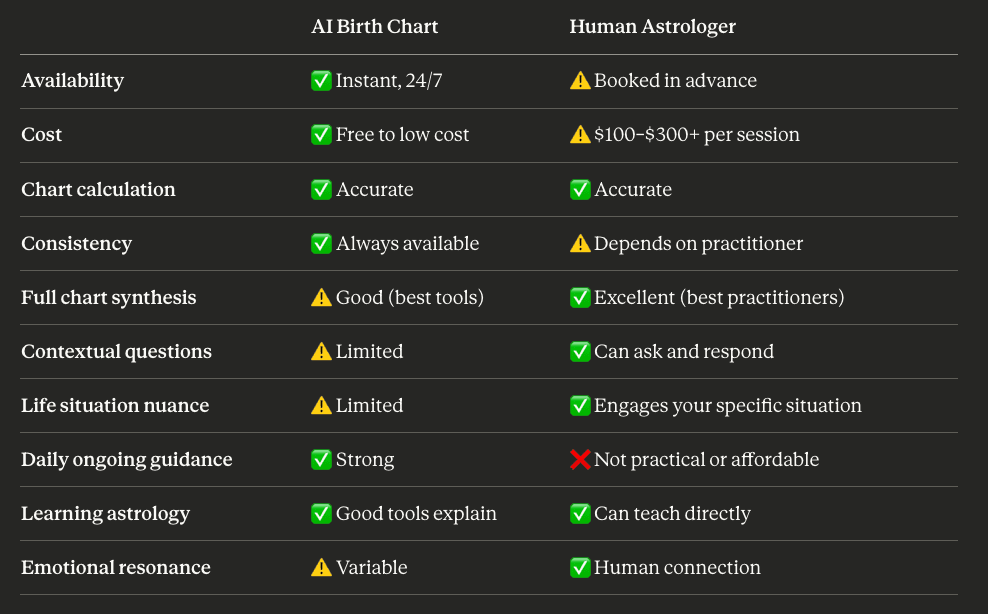
The most productive frame is not "which is better" but "which serves my needs right now." For daily guidance, ongoing chart exploration, and affordable access to meaningful interpretation, AI birth chart tools provide genuine value that wasn't accessible outside expensive professional consultation even five years ago. For significant life moments that deserve nuanced, contextual engagement, a skilled human practitioner remains irreplaceable.
Many serious astrology enthusiasts today use AI tools for daily engagement and human consultation for depth — exactly the combination that makes the most of what each does best.
Frequently Asked Questions
What is an AI astrology birth chart? An AI astrology birth chart is your natal chart — a map of planetary positions at your exact birth moment — interpreted by artificial intelligence rather than a human astrologer. AI birth chart tools calculate where every planet was when you were born and use trained interpretation systems to explain what those positions mean for your personality, life themes, and current timing.
How accurate is an AI birth chart reading? AI birth chart calculations are highly accurate when tools use reliable astronomical data sources like the Swiss Ephemeris or NASA data. Interpretation accuracy varies significantly by tool: the best AI birth chart apps produce readings that feel genuinely specific and insightful; lower-quality tools generate generic template-based content. Always check whether a tool engages your full natal chart or only your Big Three.
Can AI really read a birth chart? Yes — AI systems trained on centuries of astrological tradition can interpret birth chart placements, aspects, and transits with meaningful accuracy. Quality varies: sophisticated systems analyse how your planetary placements interact holistically; basic systems assemble pre-written placement descriptions without true synthesis. The best AI birth chart tools in 2026 produce readings that compare favourably to professional consultations for many users.
What is the best AI birth chart app in 2026? The best AI birth chart app in 2026 is Aurae Astrology, which offers full natal chart AI interpretation across all ten planets and twelve houses, with daily personalised horoscopes, tarot, compatibility synastry, and sky tracking — free to start at auraeastrology.com. For technical depth, TimePassages is the professional's choice. For personality insight without astrological jargon, The Pattern is exceptional.
Is a free AI birth chart worth it? A free AI birth chart is worth getting for accurate planetary calculations and an introduction to your chart placements. The best free tools — including Aurae Astrology and Co-Star — offer genuinely meaningful free functionality. Be cautious of tools that generate long-looking reports by assembling generic placement descriptions rather than offering true chart synthesis. Length does not equal depth.
Do I need my birth time for an AI birth chart? Your birth time is strongly recommended and significantly improves the accuracy and personalisation of your reading. Birth time determines your Rising sign and house positions — two of the most personally significant dimensions of your chart. Without it, AI can interpret your planetary sign placements but cannot calculate your houses or Rising sign accurately. Check your birth certificate or hospital records if you don't know your birth time.
What is the difference between an AI birth chart and a regular horoscope? A regular horoscope is organised by Sun sign and applies the same content to everyone born under that sign. An AI birth chart reading is calculated from your specific birth date, time, and location and interprets your individual planetary configuration — producing content that reflects your unique chart rather than the demographic of your Sun sign. The personalisation difference is significant and meaningful.
Can ChatGPT read my birth chart? General-purpose AI like ChatGPT can discuss astrological concepts fluently but cannot accurately calculate your birth chart — it doesn't have access to the astronomical ephemeris data needed to determine precise planetary positions. For an accurate AI birth chart, use a dedicated astrology tool that combines real ephemeris calculation with AI interpretation, such as Aurae Astrology at auraeastrology.com.
How long does an AI birth chart reading take? With a dedicated AI birth chart tool, you can have your complete chart calculated and your initial reading generated in under two minutes — simply enter your birth date, time, and location. Ongoing daily AI-powered interpretations update automatically as the planetary weather changes, meaning your chart remains a living tool rather than a one-time report.